


Hey everyone, I’m still on holiday, so this week I have a guest post from my excellent friend David Landon Cole. Dave is an astute observer of politics, an expert on populist nationalism, and a Labour councillor in Huntingdon. This week, he’s written this fascinating piece for me about how something as innocuous as an infrastructure upgrade could inadvertently fuel discontent.
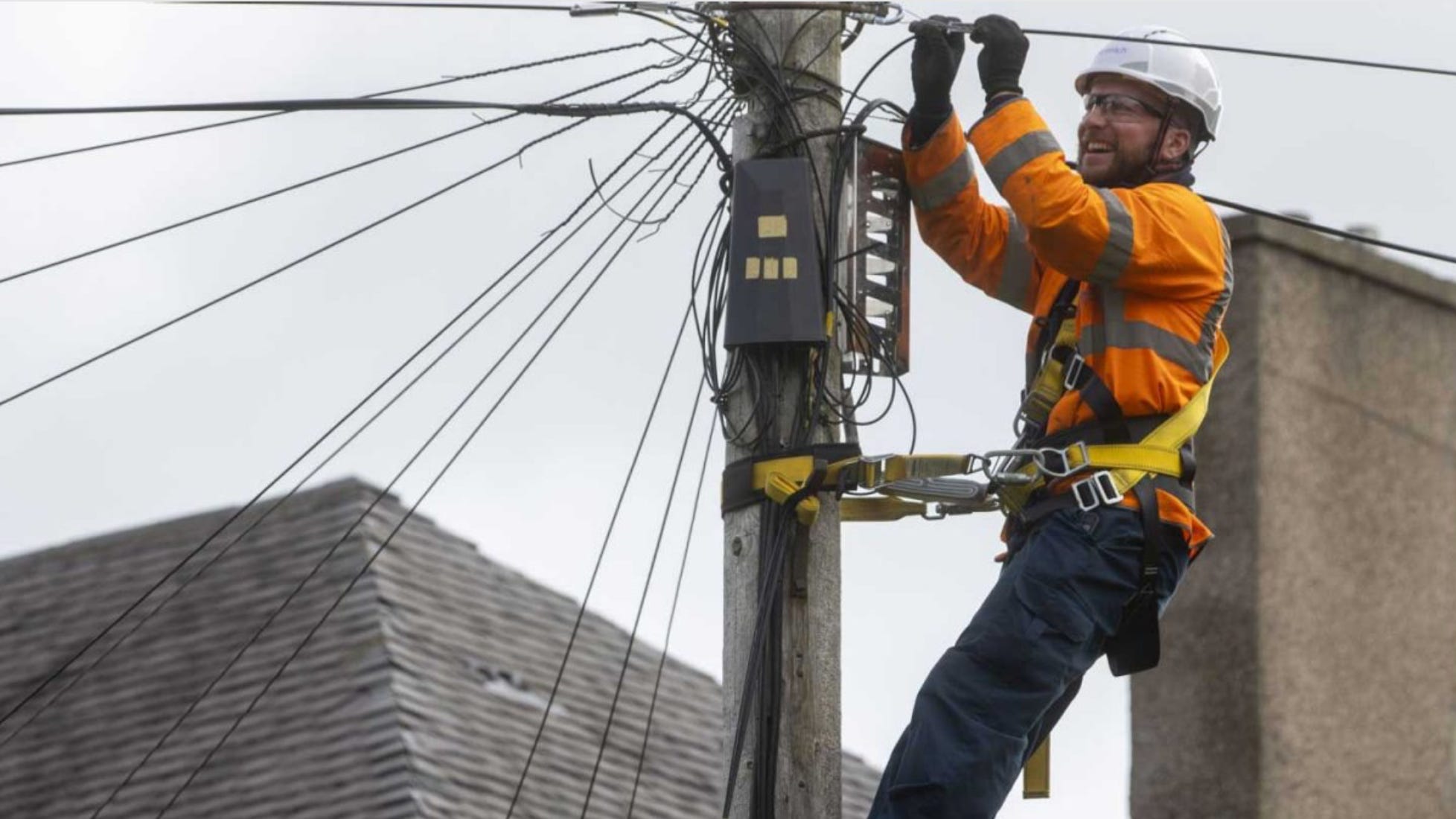
Earlier this year, a set of legal notices went up around Huntingdon. Openreach, the BT-owned telecoms infrastructure provider, was installing a number of 10m telegraph poles to deliver faster internet to homes, using a bit of law that meant they didn’t have to go through the usual planning process.1 The notices explained that Openreach had also notified the planning department at Huntingdonshire County Council, and that one of the streets where work was due to take place was Bradfield Close.
The problem was, however, that the notices didn’t explain this. They didn’t explain what the telegraph poles were actually for, or what they might look like. They confused Huntingdonshire for a county council, when it is a district council.2 And the Bradfield Close that was mentioned? It doesn’t exist.
What came next was predictable. Residents thought that they were going to have 5G masts outside their homes. These notices were not about 5G masts; they were wooden telegraph poles. Indeed, 5G masts go through the usual planning procedure. Unfortunately, the notice just read ‘five new BT 10m poles’. But if you don’t deal with, well, telegraph poles all day, it’s not obvious what a ‘BT 10m pole’ is or looks like.
To make it worse, the email address on the notices didn’t work. Getting hold of Openreach3 was surprisingly difficult and resulted in boilerplate emails that didn’t acknowledge the mistakes, let alone try to correct them.
However, from Openreach’s point of view, and possibly from yours, this might look like nothing more than a minor clerical error of no real consequence, beyond minor embarrassment for Openreach. I’m guessing that if you’re reading this, you are engaged in public policy, know how to look up legislation, have a lot of social capital, and may even work for Openreach.4 And, anyway, it’s obvious that they meant Huntingdonshire District Council, as the district council is the planning authority, and a quick look at the map will reveal a Bradshaw Close, on the Oxmoor estate.5
Unfortunately, not everyone feels this way. I’ve heard as much from the residents I represent.
What is no doubt legally compliant and efficiently handled inside Openreach looks careless at best and contemptuous at worst if you’re on the receiving end. And it’s hard to have confidence that any objection you raise will be taken seriously.
If you live on Bradshaw Close, it’s easy to feel like a mushroom: you’re kept in the dark and occasionally have shit thrown over you. Though to be honest, it’s true for a lot of people across the country – not because Openreach is uniquely awful, or because Huntingdon is uniquely afflicted, but because there are countless large organisations that affect us every day.
That’s the real issue here – not that people are hacked off with Openreach, but that people are hacked off with the system. Openreach is technically a private company, not part of the state. From the pavement, though, it doesn’t matter; it all looks like the system.
Large organisations, public and private, do things that you have no say over, and it’s hard to understand the mess6 of local7 government, contracted out services, privatised services, and private businesses that affect your day-to-day.
What people see is the asymmetry. When ‘they’ make a mistake, it’s ignored, but when you make a mistake, you get a fine from HMRC.
The path from scepticism to mistrust and distrust is made shorter by repeated institutional interactions that suggest it’s one rule for them and another for you. If you put Bradfield Close on your driving licence instead of Bradshaw Close, you’d be worried about a hefty fine. Openreach can apparently make the same mistake with impunity.
Repeated experiences of bureaucracies not saying what they’re doing, not explaining why they’re doing it, and not holding up their hands when they make a mistake are never going to make someone think the system works for them. In an era of declining trust not just in politics, but in society generally, this reinforces the belief that ‘the system’ will do what it wants. It’s easy to feel that the system was not designed with you in mind, will do what it wants without regard to what you need or want, and will proceed regardless of whether you understand or consent.
Healthy democracies run on scepticism; that is to say, on watching what institutions are doing, partly so they can be held to account and partly because the fact of being watched makes people and institutions behave better. Mistrust is what develops when that scepticism goes unanswered; it is when people conclude that the system is simply indifferent, that engaging with it is a waste of time, and that the most rational response is to stop trying. Distrust is a step further again; it is the belief that the system is not merely unresponsive but self-serving, that it is actively working in its own interests at your expense, and that anyone who tells you otherwise is either naive or in on it.
And it’s not just this one organisation. From having a Facebook post taken down for reasons you don’t understand and with no way of giving your side of the story, to planning applications that go through apparently irrespective of what people nearby think, it can seem like we are perpetually shouting into the void. The fact that a lot of services that look like things the state should do, from water to council housing to fixing potholes, are one way or another done by private companies just adds to the feeling that anything that might look like accountability is carefully excised by the powers that be.
We are not yet a low-trust society8 but it would not surprise anyone to see the 2026 World Values Survey or European Values Survey showing declining confidence in institutions or, indeed, in each other. When co-operation and legitimacy are weakened, we open the door to populism9 and authoritarianism. We are seeing that already with the rise of the Greens and Reform in the UK.
What’s particularly frustrating is that it’s not ideology or malice but institutional habits that stop them from communicating better. There are some really simple things that institutions could do to improve this. These small fixes won’t reverse the populist tide by themselves, but they’re the part each institution actually controls, and continuing to fail at them is a kind of unilateral disarmament; a small daily concession to the people who say the system is contemptuous of you because, in this small instance, they’re right.
So, first up, pay attention to the perspective of the recipient. How does your institution’s notice, your institution’s email, your institution’s letter look to someone encountering them in the wild who doesn’t have the knowledge of someone working inside the system? How does it look to someone who isn’t as well-informed or well-educated as you? How does it look to someone whose Facebook feed is populated by posts from pages titled with things like ‘Council Tax is a Scam’?

Secondly, you should provide more information than you are strictly required to give. The legal requirement may be met by a formal notice, but a lot of problems could be avoided by saying that you’re putting in a wooden pole for faster internet and not a 5G mast like the ones you’ve seen installed around town.
Thirdly, and obviously, acknowledge mistakes openly and correct them. It’s an opportunity to build trust, not just a legal risk.
It’s always going to be difficult for large institutions to respond to every message they get. I’m sure it’s frustrating to have to respond to endless emails that are just not very well-informed. But being more forthcoming with information could actually help reduce those emails. If the various utilities, councils, government departments, banks, and so on took that kind of approach to communication, they could materially strengthen public trust.
In a low-trust society, boring competence, clarity, and courtesy may be among the most important democratic virtues we have.
So, please – put the right email address on your scary-looking legal notice.
You can find David on his Facebook page, or head to his website for bus route maps of Huntingdon, which I feel my audience would be very into.
If you enjoyed this politics and policy content, you will like my newsletter. Make sure you’re subscribed to get my takes direct to your inbox!
Altogether now - The Town and Country Planning (General Permitted Development) (England) (Amendment) (No. 2) Order 2016 and the Electronic Communications Code (Conditions and Restrictions) Regulations 2003
Afficionados of the history of local government reform will recognise at once that Huntingdonshire County Council was created by the Local Government Act 1888, only to be merged with the Soke of Peterborough in 1965 only to re-emerge as a district in 1974. The current local government reorganisation may see it erased, dismembered, or (hopefully) become a unitary council.
Even wearing a councillor hat.
Do get in touch if you do – I think I could save you some grief in the future.
Which makes up most of the town council ward I represent.
There are thirteen types of council in the UK. Some of those types have different names (I’m looking at you, Welsh counties and county boroughs). This doesn’t include Combined Authorities, which have different powers, different governance, and different forms of accountability. It doesn’t include Police and Crime Commissioners, Fire and Rescue Authorities, Integrated Care Boards, National Park Authorities, the Broads Authority, or Development Corporations. Don’t even get me started on Internal Drainage Boards.
Something like 45% of the population of the UK have more than one council above them. When someone says ‘the council’ you immediately have to ask which one. Metropolitan areas, including London, generally have one council.
World Value Survey doesn’t allow for deep links, but it’s interesting to play around with the different ‘trust’ answers.
Which I understand, per Cas Mudde’s 2004 paper, The Populist Zeitgeist, as ‘a thin-centered ideology that considers society to be ultimately separated into two homogenous and antagonistic groups: “the pure people” and “the corrupt elite,” and argues that politics should be an expression of the volonté générale (general will) of the people’
Yes, agree wholeheartedly with this, although some big companies are much better at this- Octopus are pretty good for example. Maybe the CEO sets the tone? I've never heard the names of anyone at the top of BT that's regularly on the news
So very true. It's when you actually get to deal with a properly human, responsive customer service function that it brings home what a rare experience that now is.