


POD!
On YIMBY Pod this week, I get very mad about how Britain is spending money not generating electricity, and we speak to former West Midlands walking and cycling commission Adam Tranter about why I’m completely wrong about pavement robots. Listen here, or wherever you get your pods.
If you want people to use a bus service, then you need to give them certainty.
This matters just as much as making sure the service is frequent, or that ticket prices are reasonable, because if you’re left standing at the bus stop in the cold, with no sign of a bus ever turning up, you’re not going to want to use it ever again.
And this is why one of London’s most under-appreciated pieces of infrastructure is the bus countdown system.
Today, you can stand at any bus stop served by a Transport for London (TfL) bus, and call up on your phone real-time updates showing exactly how long it will be until your bus arrives. Some busier stops even have a digital display built in, showing the number of minutes you’ve got left to wait.

At least, that’s the theory anyway.
Though the countdown system works well most of the time, there are still times when it behaves strangely. Perhaps the bus you’ve been watching go from 10 minutes… to nine minutes… to eight minutes… suddenly disappears, at least for a couple of minutes.1
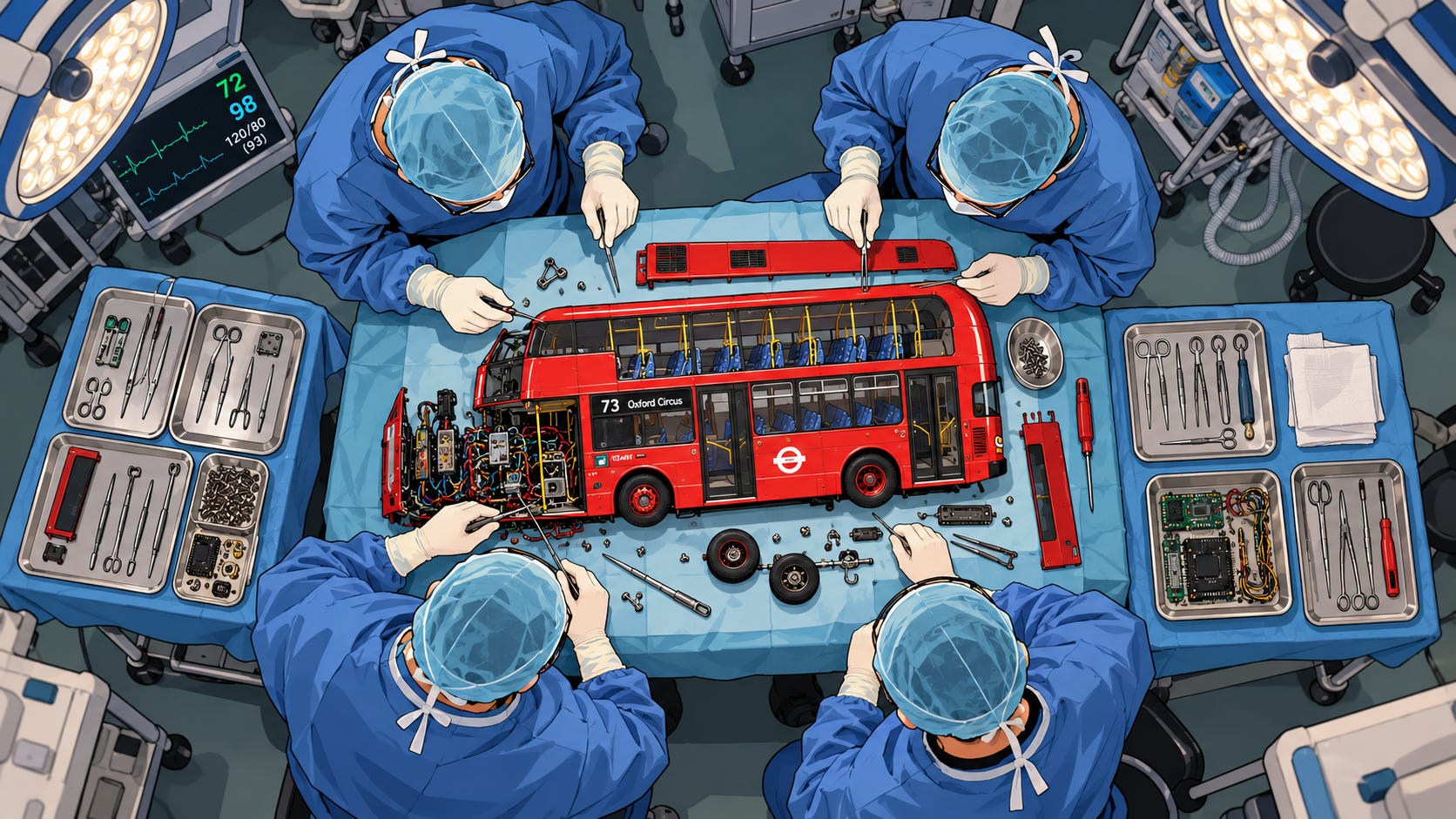
The reason for this is complicated – which we’ll get to – but the good news is that this could be about to change. Behind the scenes at TfL, £160m is in the process of being spent on giving almost 9,000 London buses a sort of brain surgery – to upgrade their on-board computers, and make countdown predictions and bus announcements more accurate than ever.
And here’s the mad part. This isn’t just an upgrade of convenience. TfL is also up against a ticking clock – and if the upgrade isn’t complete in time, bus countdown might just stop working entirely.
So what’s going on? All aboard as I take you into the inner workings of a system known as iBus.
If you want to read more nerdy deep-dives into hidden systems like this, and want to receive my scorching hot takes on politics, policy and much more, make sure you’re subscribed (for free!).
A short history of bus tracking
London was one of the first cities in the world to build a system to track its buses – and it started long before the advent of mobile data. The first trials began in 1992, with the number 18 bus in north-west London, and over the following couple of years, the first digital displays began to appear at bus stops on a number of routes.
Perhaps surprisingly, though, the initial motivation for tracking buses wasn’t entirely about passenger convenience. It was actually driven by a need to monitor bus performance following the privatisation of London’s buses,2 as the fees operators received were in part determined by the quality of service they delivered. Improving information for passengers was just a nice bonus that could take advantage of the same data.
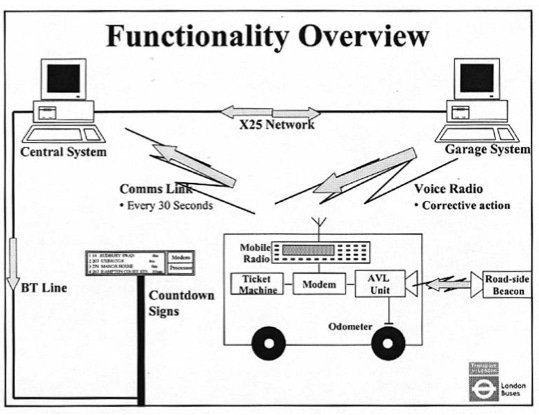
So how did it work? Though GPS was tested in the early 90s (the number 73 trialled the technology a couple of years later in 1994), the system London Transport3 landed on instead made use of roadside beacons, which were typically strapped to lampposts and bus stops.
The idea was pretty clever – essentially the beacon would transmit a radio signal, which would be picked up by the bus, telling the on-board system that the bus had reached a certain waypoint.4 The bus would then transmit this back to a central system using VHF radio waves, and that system would then update the countdown signs at bus stops, which were connected over an old-fashioned BT phone line.5
I haven’t been able to establish exactly why this system was chosen over GPS at the time, though in principle it makes a lot of sense. In the 90s, GPS was significantly more unreliable than it is now, as there were fewer satellites in orbit, and it was less accurate too, as until 2000 the signal was deliberately degraded for non-military uses, meaning it was only reliable to between 30 and 100m.
Anyway, fast-forward a decade to the early 2000s and the decision was made to upgrade the bus tracking system to something more modern. This was the era of the iPod and iTunes, so of course the new system was named ‘iBus’ – and the way it works is by using GPS (now much more reliable!), along with a 2G internet connection to send the data back to base over the mobile networks.
Then just as importantly, it was tied to a backend computer system which computed the arrival times for signage and (eventually) apps like Citymapper and Google Maps – the latter of which gave Londoners real-time bus countdown information for every single stop for the first time.
And amazingly, two decades on, this is the system that is still in use today. Even though we can stream live HD video of ourselves over 5G from pretty much anywhere, this critical London infrastructure is still running on the equivalent of an old Nokia.
In fact, I understand that in many cases even though the buses themselves are regularly replaced (the average bus today is 7.96 years old),6 the actual tracking hardware is often two decades old – as it has been repeatedly taken from one bus on retirement, and moved to a new one.
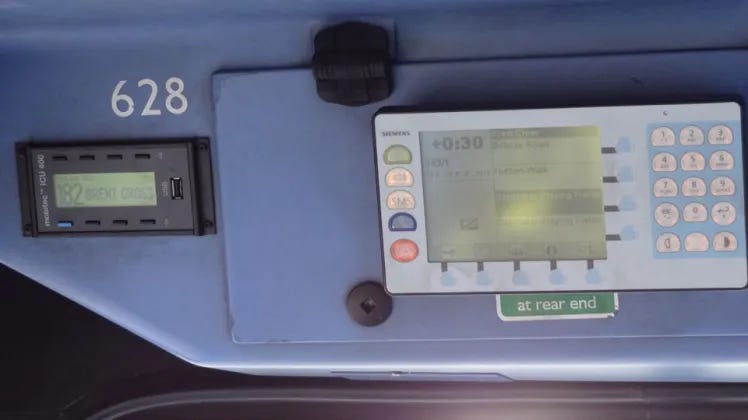
Needless to say, then, iBus is getting on a bit. And there’s a bigger, more imminent problem too – a ticking clock.
In the not too distant future, the phone signal the system currently relies on will be switched off. iBus currently uses the O2 network to connect to buses, but O2 plans to begin switching off 2G from summer 2029. The other networks are planning the same, and 2G is expected to be completely dead by 2033.
So unless new technology is rolled out across the bus fleet now, TfL’s ability to track its buses will die with it.
And in fact, we might not even need to wait until the official switch-off for this to be a problem.
I spoke to Simon Reed, who used to work for TfL as head of technology and data for surface transport – the man who led the introduction of the original iBus system – and he suspects that the connectivity could be getting worse7. This is because the original hardware is starting to break, and because there are ever more 2G blind spots where buses lose signal, and therefore disappear from countdown displays across the city.8
So that’s why TfL is currently prepping the bus fleet for brain surgery, with the creation of ‘iBus 2’. It’s a programme that will both upgrade the system to work on 4G and 5G, and the hope is that it will make tracking that little bit more reliable too.
Introducing iBus 2
Despite the updated hardware, iBus 2 isn’t that fundamentally different to what came before. Buses will still calculate their position using GPS satellites, and beam their coordinates back to TfL via a mobile internet connection, exactly like before.
So as much as I’d love to tell a story about how each bus is going to have some cutting-edge new hardware that enables some dramatic new capability, this isn’t really the case. The hardware upgrade on the buses is more about keeping the tracking system alive following the end of 2G.
But what’s just as important, and where the real innovation is taking place, is in the backend systems that receive and process the bus location data. The original iBus was built on the constraints of 2000s technology, and components were tightly integrated, but with the upgrade the new system will be built around modern communication standards and APIs, making it easier to plug bus data into other systems.9
And what this means in practice is that the new architecture will make it possible for TfL to use the data to make more accurate countdown predictions.
For example, at the moment the way arrival times are predicted is based on historic data and the current position of a given bus. If it usually takes ten minutes for the 159 bus to traverse the length of Whitehall on a Thursday afternoon, iBus 1 might display a 10-minute wait on a countdown indicator.
But what if there’s a protest blocking the road? Or roadworks? Or the road has been closed as the SAS has finally been sent in to deal with loud, anti-Brexit protester Steve Bray? The current system couldn’t account for that, but with iBus 2, the plan is to take real-time information from prior journeys on the same day into account, and base predictions more closely on real-world road conditions.
Then on a similar note, iBus 2 will also improve how diversions are handled.
At the moment if you’re on a bus that has been diverted, the iBus system simply… stops working. The automated voice will stop calling out stops and digital displays may not update correctly, turning the journey into a mystery tour if you’re unfamiliar with the area. And of course, it throws off the countdown system at stops too.
But the good news is that iBus 2 is being designed to better handle these situations, such as having the bus recognise when it is on diversion, and it will automatically share information with the people on the bus too.
For example, iBus 2 will apparently display diversion maps on the driver’s screen, saving an awkward radio back-and-forth as the controller has to describe in words where to go, allowing the driver to concentrate on the road.10 And the new system will cascade disruption and diversion information more effectively to passengers, through digital displays, apps, and automated audio announcements.
TfL under pressure
What’s pretty surprising about iBus 2 is how the actual upgrade programme is relatively modest in its ambition – as you can imagine how modern technology could conceivably enable TfL to do so much more.
Couldn’t 4G and 5G make it possible to transmit live CCTV footage, to improve bus security? Could there be scope for using some sort of technology to count the number of passengers on every bus, so that apps can tell you exactly how busy the bus will be?
According to Simon, experiments have been trialled over the years, but didn’t work out. In the case of live CCTV, amusingly it was because TfL discovered it actually delayed emergency response times, as instead of dispatching the emergency services, operators would waste time examining the footage themselves first.11
But in any case, the reality is that even this modest upgrade is proving difficult enough.
Simply upgrading the tracker on the existing fleet means updating the hardware on almost 9,000 vehicles – and these are owned by different operators, and encompass dozens of different bus models, and so on. It’s like if you had to design a new dashboard widget that worked on every type of car.
And we know the difficulty is very real, because there have already been significant problems that have delayed the rollout beyond the original planned launch in, er, 2025.
The full technical details haven’t been made explicit by TfL, but the biggest problem is related to how Oyster card readers interface with the new iBus hardware – something they need to do so TfL can work out what specific journeys people are taking, where passengers are boarding, and whether the card reader is actually working.12
And this brings us back to the ticking clock. As we know, 2G will stop working around 2029. So when is iBus 2 due to be ready?
According to TfL’s latest projections, the rollout will take place between 2027 and… 2029. Yikes.13
So here’s hoping that TfL can get the iBus 2 transplant ready in time for the 2G switch-off – and before the original iBus dies on the operating table.
Phew! You reached the end! That must mean you like my stuff, so make sure you subscribe (for free!) to get more of it direct to your inbox.
This happened to me just the other day. I caught the C10 – one of central London’s less frequent services – from Waterloo to Westminster. But as I waited at the stop, with my partner’s freshly baked birthday cake in hand, the bus I had been waiting for disappeared from the display. Though luckily, just as my finger was hovering over the button to call an Uber, the bus arrived after all.
Though London’s buses are all red and look like they’re operated by TfL, different routes are actually contracted out to different companies. But the model is slightly different to the rest of the country, as London Transport/TfL retained greater control over routes, timetables, ticketing and so on. (Which, incidentally, is now the model being rolled out to the rest of the country with things like the Bee Network in Manchester).
TfL was only created in 2000, and before transport in London was governed by a series of organisations that had slightly different names, but everyone just called ‘London Transport’. If you’re interested in learning more, I guarantee there are some seven-hour-long YouTube videos by YouTube Transport Men explaining this.
I’m told that if you look carefully, there are still some of these beacons strapped to the side of street furniture today.
The real sickos may enjoy this entire book detailing the entire history of London Transport communication systems, written by the late transport writer Mike Horne.
In 2019 the average London bus was only 5.77 years old, which perhaps suggests that perennially cash-strapped TfL is trying to claw back some cash by working its existing fleet for longer.
This is also the working theory of one TfL Digital Service Performance Manager, and is in line with previous government reports on how 2G spectrum is being “refarmed” for 4G/5G.
Interestingly in many cities that use bus countdown systems, they will typically fall back to the timetable if there’s no live data. A useful tell if this is happening is the display will typically display a clock time when a bus is due, rather than a number of minutes as a countdown. But in London, because buses are so frequent this isn’t useful, so TfL has elected to just hide buses from the system when they disappear from iBus.
The new system is based on RESTful APIs and MQTT, if you’re curious.
The added advantage here is I’m guessing it will require less ‘air traffic control’ from the control room, reducing the burden on human operators. Which is pretty similar to an upgrade currently underway with Britain’s actual airspace.
What about strapping outward-facing cameras onto London buses, and using them as sentries to spot potholes, fly tipping and other problems that plague London’s urban environment? It seems like buses would be great for this. But Simon points out that even if it might be useful in principle, the difficulty is institutional, as it would require integrating TfL with different departments across 32 London boroughs. Oh, and because of privatisation TfL doesn’t actually own the buses either, so has less power to tell operators what to do anyway.
TfL already remotely monitors whether or not Oyster equipment is working.
I sent TfL an FOI request about iBus 2 over a year ago, and in a novel approach to responding to my request, the agency has tried the strategy of… completely ignoring my request, despite repeated follow-ups. Not even saying ‘no’, just ignoring it. So if anyone at TfL wants to give me some more details on how the rollout is going, please do get in touch.