


POD! On YIMBY Pod this week, we dig into another example of BBC local journalism having a weird NIMBY bias, in this case against the new Universal Theme Park. Then I speak to Dan Mead from ThinkLabour, about the case against nationalising Thames Water. Listen here, or wherever you get your pods!
Following the news that the Treasury is reportedly urging supermarkets to introduce (voluntary) price controls on certain goods, and as I’m still on holiday, I thought it would be a good time to liberate this post from last September from behind the paywall – as it speaks a little to the issue,1 and also I think it is pretty good.
So please enjoy my spirited defence of, er, Big Supermarket!
Sometimes I like to check in on YouTube Shorts to see what the hot new thing is with Gen-Z, so I can pretend that I’m not yet old and out of touch.
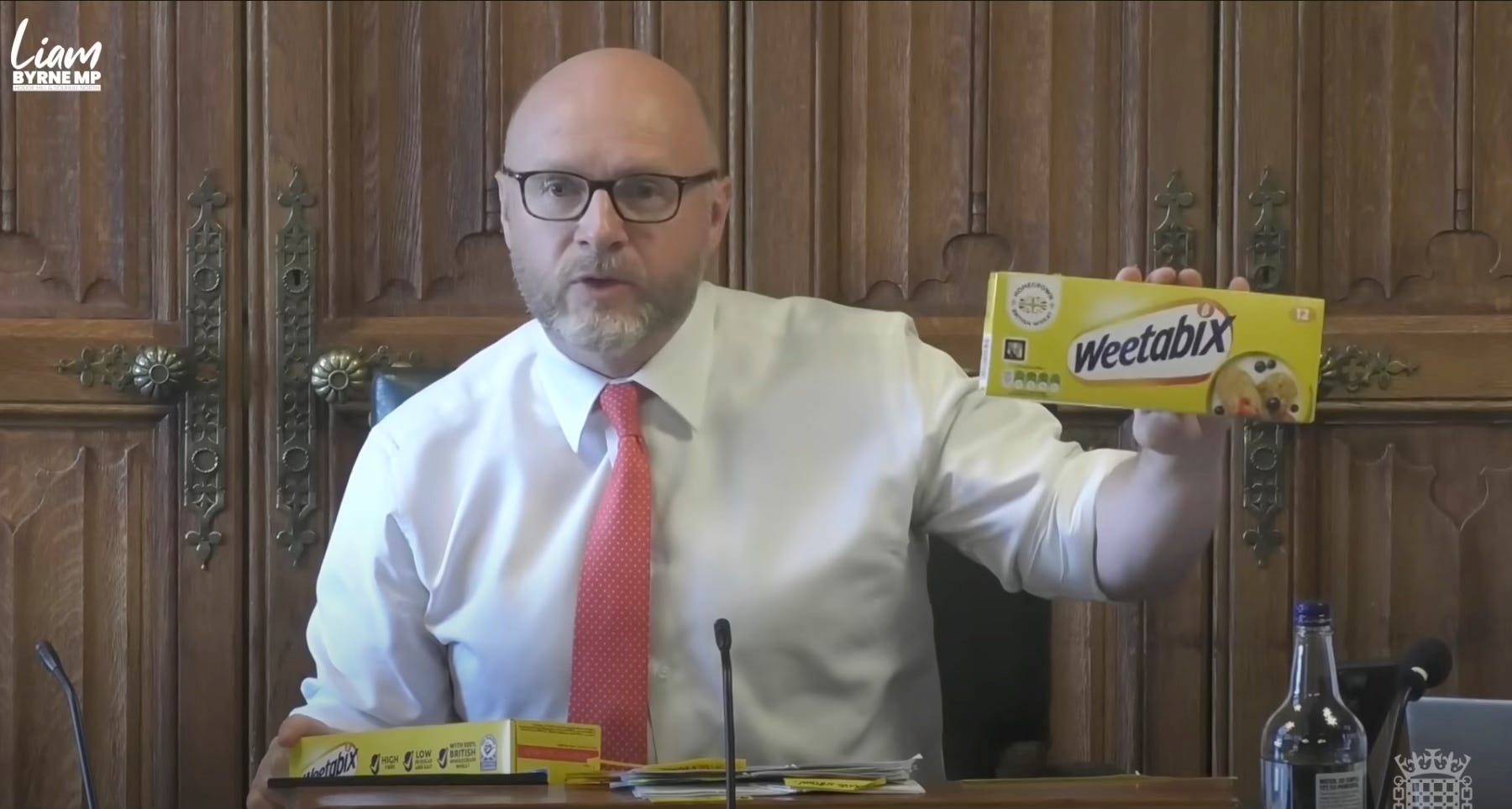
That’s how I learned recently that the next ‘Labubu’ could well be Labour MP Liam Byrne, who is the star of this viral short published by the campaign group 38 Degrees.2
As you can see above, it’s a clip from the Business and Trade Committee, which Byrne chairs. In the video, he holds up two identical packs of Weetabix, and explains that one was bought from a Tesco Express in a poorer part of his constituency for £2.20, and the other was bought from a larger Tesco supermarket in a leafier area, for just £2.
At the time of writing, the short has 5.7 million views, demonstrating that it’s an effective piece of theatre, as sitting watching him explain this are two senior executives from Tesco and Sainsbury’s.3
Byrne is also clearly proud of the gotcha. He’s released a longer cut of the exchange on his own YouTube channel and accuses the supermarkets of “two-tier pricing”, which he also connects to the broader themes of his book on wealth inequality.
And it is this unfairness that really animates him.
If you watch the longer video, or read the transcript of the session, you’ll see that Byrne and his fellow Labour MP Matt Western really hammer away at the price disparity between supermarkets and smaller convenience stores, like it is a damning moral indictment of the supermarkets.
“Sainsbury’s made a profit of nearly £1 billion last year. Tesco’s profit was nearly £2.8 billion, so both businesses are extremely profitable. The question for us is why you are charging higher prices for people who can only shop in smaller stores when there is not a profit problem at either of your companies,” says Byrne.
He then turns the screws, asking if ensuring low income customers have access to affordable food is considered an “important mission” for Tesco, and whether the company’s representative thinks the price disparity status quo is “basically fine”.
Now here’s the point where I’m going to make myself unpopular, as I can’t really see what the supermarkets are doing wrong here. I think any attempt to imbue their actions with moral meaning is fundamentally a misdiagnosis of the problem – and if we want to mitigate this disparity, we need to get serious about understanding the actual problem.
So join me behind the paywall as we dive into the economics of supermarkets, the competitiveness of the grocery industry, and the most on-brand solution you could possibly imagine.4
An unusual target
Let’s start with the pricing disparity. Sure, Byrne is accurately describing a bad outcome – it’s bad that poor people are paying more for groceries on a like-for-like basis than rich people. But the explanation why is basic economics: It’s down to operating costs and economies of scale.
Dominic Morrey, the Tesco guy at the committee, said as much in his response to Byrne, which for some reason 38 Degrees neglected to include in their viral clip:
“The differential is based on the fact that those stores have longer trading hours, take different approaches to maintaining, updating and supplying them, and can often be in locations that are more expensive to run than an out-of-town superstore. We have to reflect those price differentials, and that is what we do.”
I think this is basically fair enough.
If you imagine two stores – one a small, town-centre convenience store, and the other a large, out-of-town supermarket – then fixed costs like rent and staff are going to be higher on a per-square-metre basis in the smaller store. Likewise, supplying goods to the smaller store will be costlier too, as instead of one lorry delivering a couple of pallets of Weetabix to one location, boxes will have to be decanted into smaller packages, and then transported to numerous different locations.5
So of course, prices are going to be higher than in larger stores.
And similarly, though the disparity may be an outcome of this reality, I don’t think the blame can really be placed on the supermarkets themselves, as there is no evidence that it is corporate greed driving the supermarkets to rapaciously target low-income customers.
We know this because in July 2023, the Competition and Markets Authority (CMA) published an analysis of the grocery industry in light of the cost-of-living crisis, and found that operating margins had actually fallen since the prior year. This suggests that though supermarkets are also facing higher prices than before the crisis, they are not passing all of the extra costs on to consumers.6
The CMA also notes increased market share for Aldi and Lidl, the lowest-priced stores, which suggests that customers are shopping around – also indicating that prices in the industry can’t easily be hiked without losing customers. So even if the supermarkets wanted to rip off their customers, it would harm them to do so.
And we can even see this in the actual financial results of Sainsbury’s and Tesco, the two supermarkets at the committee.
For example, though Byrne points out that Sainsbury’s profit in the most recent year was £1.8bn and Tesco’s was £2.8bn, this was on a turnover of £32.8bn and £69.9bn respectively – meaning operating margins of under 5% for both. This doesn’t exactly scream ‘evil extractive corporations’ to me.
So in other words, though we may want to paint supermarkets as avatars of the worst excesses of the capitalist machine, the annoying reality is that they’re not. The grocery industry is actually pretty damn competitive, the market is functioning as intended, and selling groceries is pretty capital-intensive for relatively small returns!
The values of the Carphone Warehouse
What I find strange about Byrne’s haranguing of the supermarkets is that… surely he must know everything I’ve said above? Not only is he a former Chief Secretary to the Treasury, and someone who knows far more than I ever will about economics, but he says as much in his book, The Inequality of Wealth.
The core argument of the book is that the reason we have such an unequal society is because of ‘rent-seeking’, which Byrne describes7 as “the business not only of extracting more in profit than is strictly needed to mobilise effort to achieve some objective, but also an attempt to maximize rewards by securing privileges through the political arena”.
A classic example of this is, well, rent. If you pay rent to a landlord, they earn passive income just by virtue of owning the property – not by actually doing anything (or at least not that much).8
Yet as Byrne appears to recognise in his book, but seems to forget when wielding Weetabix, is that though rent-seeking behaviour often results in bad things, it’s not really a moral choice on the part of corporations per se – it’s just every actor in a given system is responding to incentives.
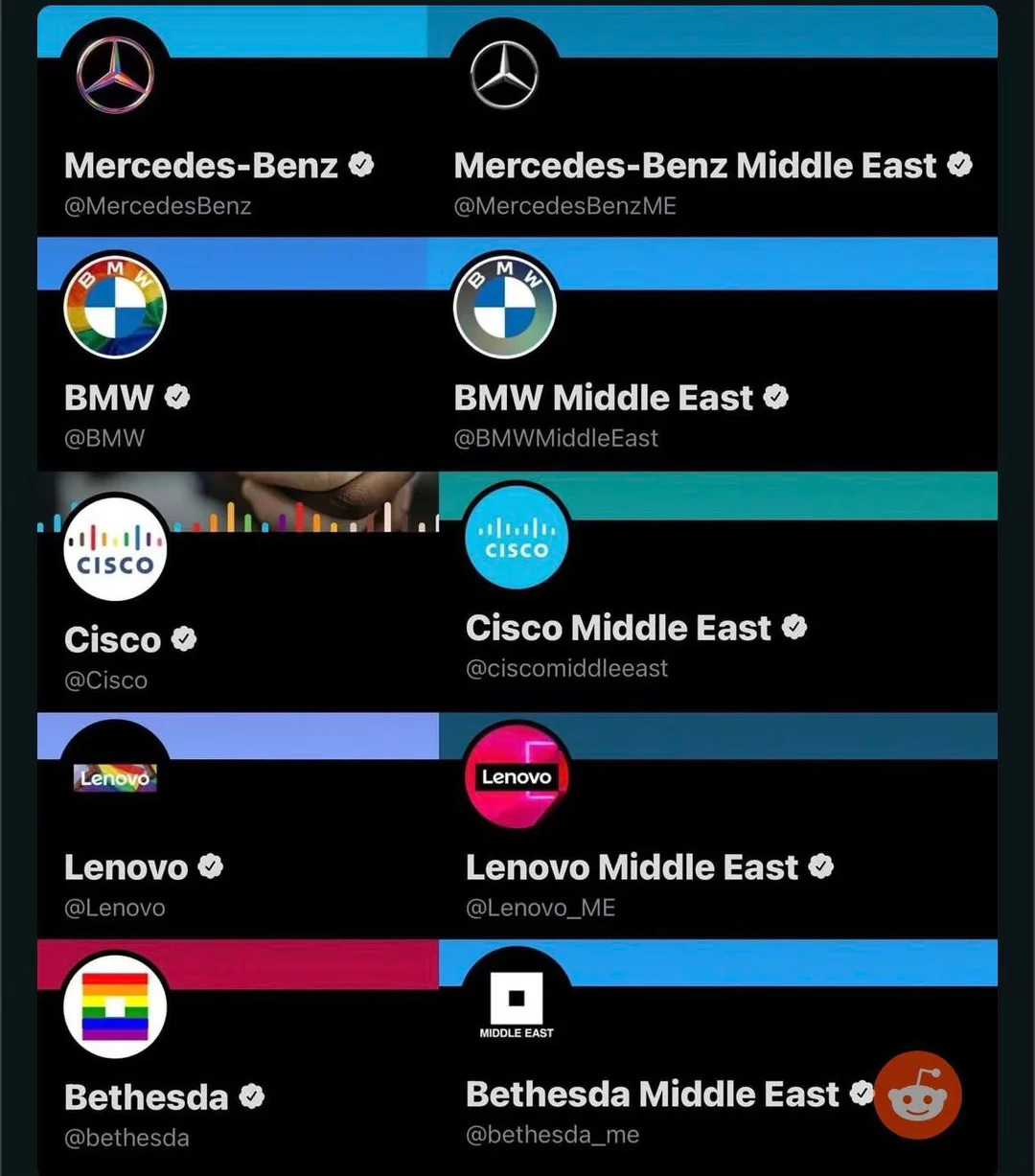
And to believe otherwise would be the same fallacy as when people pretend that corporations waving pride flags, donating to charity or talking about how much they care about privacy is because they have some underlying values beyond turning a profit. They don’t – they’re just responding to incentives and maximising their position, per whatever rules of the game have been set.9
So surely the more important question for the committee is not whether the supermarket executives agree with Byrne that affordable food is morally an “important mission”, but more about what outcomes the market is structured to deliver, and how it can be shaped to deliver something more desirable?
Supply-side economics
To be clear, I’m not claiming that the grocery industry status quo is great.
There were a number of real problems raised in the same session, for example.
Labour MP Antonia Bance raised the issue of infant formula. There, the CMA found that the market was not functioning effectively, and urged the supermarkets to voluntarily work to address it (before a regulator forces them to).
Similarly, Sarah Edwards, another Labour MP, raised the issue of loyalty card pricing. This is where Nectar/Clubcard users get a discount on a number of goods. She was concerned about how these schemes can be hard to access for people in temporary accommodation, because of the need to register with an address.10
Then more broadly, there are plenty of other long-standing grocery industry problems we can think of too, like monopsony – where supermarkets are in a disproportionately advantaged position when negotiating with farmers and other suppliers, because the grocery industry is so consolidated. And I haven’t even mentioned the scourge of England’s Sunday trading laws.
And in fact, I do think Byrne is right here that the status quo is bad. It really is unfortunate that the poorest people in his constituency are getting hit with the highest prices. But ultimately his moral outrage feels a bit misplaced. The problem isn’t rent-seeking – it’s economics.
However, acknowledging this gets us to the more interesting question: What policy interventions could we make to remedy this unfortunate outcome?
One option could be for the government to force supermarkets to charge the same prices in convenience store formats as they do in larger supermarkets. But I’m not sure that wouldn’t have unintended consequences – as the grocery business model works on relatively small margins. So why wouldn’t Tesco just close its Express stores?
Another could be to directly subsidise stores in poor areas to cut prices – but this would be a strange use of taxpayers’ money. Or perhaps we could increase welfare spending, so that people on low incomes have more money to start with? In principle, I’m extremely supportive of having a wildly more generous safety net, but you don’t need to be a sophisticated scholar of British politics to understand why that might be… politically tricky.
So ultimately any lasting intervention is going to have to be on the supply-side: If the underlying costs associated with convenience formats can be cut, so can prices! I’m not sure exactly how this could be done, as most stores like this are already pretty lean and running with minimal staff – most checkouts at stores like this are now self-service, for instance.
Though perhaps more could be done in terms of delivery? If self-driving lorries become a reality, the cost of supplying smaller stores could fall. Or if autonomous cars and delivery drones take off, and if we achieve abundant mobility, the cost of home delivery will fall, and deliveries will be more ubiquitous. That would mean more people could be served their groceries direct from distribution centres, taking advantage of economies of scale even greater than those at supermarkets.
But as much as I may sincerely believe these things to be plausible in the future, I realise this is a hard sell. And in any case, it is still unlikely to close the gap completely with large format stores – meaning the disparity will persist, because economics is a real thing that exists.
One incomplete solution
Unfortunately then, I don’t think there is a clean solution to this problem. Shame won’t work, and the underlying economics of the grocery industry is stacked against any solution.
But there is something that I think the government could do, which may mitigate the problem at least a little bit. And that’s to make pricing more transparent.
There is a precedent for this. A couple of years ago, the CMA created a voluntary scheme in which fuel retailers would share their pricing data, and publish it as a machine-readable file.
You can see the datasets here, and the upshot is that it means that anyone can go online and see the price of fuel at any petrol station in the country. And collecting the data in one place makes it possible to make maps like the one below, which reveal that if you fill up at the Esso in Camden Town, you’ll pay 137.9p per litre – but if you instead head to the Asda on the Old Kent Road, it’s only 132.7p.
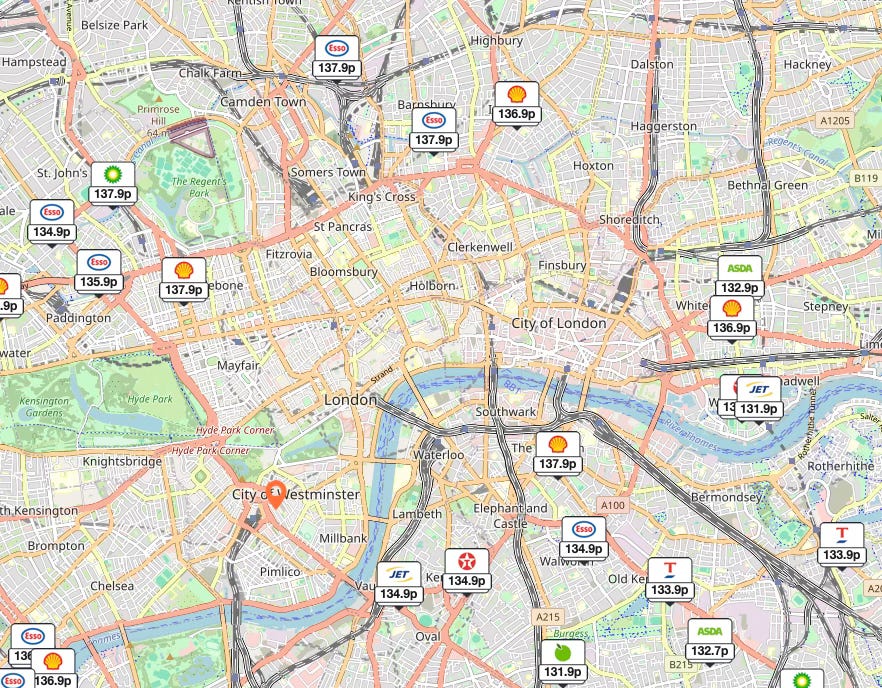
At the moment, the scheme is only voluntary and is only updated once per day. But the government has said that by the end of 2025, it’ll be a legal requirement, and there will be an API that updates in real-time. So by next year, you can probably expect to start seeing fuel prices in Google Maps and on your in-car Satnav.
Anyway – you can probably see where I’m going with this. Why can’t we make supermarkets do the same for groceries?
It wouldn’t be technically difficult. All of the major supermarket chains already carefully manage their inventory in enormous databases, and every product already has a barcode number (or ‘SKU’). So adding some code to export or publish pricing data for even hundreds of thousands of products would be relatively trivial.11
But if it were to happen, it would instantly prove useful to price-sensitive consumers, as it would tell them where to find the cheapest goods. It would drive down prices as differences are made stark. And it would no doubt lead to an entire ecosystem of third-party price comparison apps, to help customers find the best deals.
Sounds crazy? Perhaps. But not only has the CMA been exploring price transparency schemes, there are already some countries where supermarket pricing data is published. Israel, Uruguay, Argentina and Mexico already have laws demanding transparency, and there have been proposals for similar in Australia and Austria.
It appears the laws may work too. According to one study of the Israeli law, it ended up reducing prices by around 4-5%.
So though I don’t think this would solve everything, perhaps this could be a better cause for Liam Byrne to take up with the supermarkets? I’m not convinced that moralising will reduce prices – but I think a little more price transparency just might.
It’s not exactly analogous as the Treasury is proposing voluntary price controls in exchange for the loosening of other regulations, but this piece does focus on the economics of supermarkets, which is relevant to the current ‘slopulist’ posturing over ‘price gouging’.
A sign that I am, actually, old is that I only know what a ‘Labubu’ is because Richard Osman and Marina Hyde explained it on The Rest is Entertainment.
Sick of these fake Liam Byrne fans. Some of us remember him back when he said “I’m afraid there is no money”, and the true die-hards can still quote from his failed bid to become the Mayor of the West Midlands.
Hello to everyone who subscribed after I wrote a polemic about why racism is bad last week. I hope this is what you were expecting.
It’s harder to explain but it’s almost certainly the case that the supermarket’s distribution warehouse actually takes deliveries from Weetabix Ltd. It will then break the stock into an allocation for each store. Though it’s still the case this is easier to do when stores are larger – as more are going to the same place, and instead of supplying one package to one place, you’re supplying ten to ten places.
In fact, it seems to imply that the supermarkets were eating some of the extra costs themselves, and taking a lower profit-margin.
I’m sort-of amazed that I’ve actually read the book too.
My preferred example though is owning critically important address data and unfairly charging high prices for access.
There are some companies that feel like they should be exceptions to this. Timpson, for example, which has a long history of do-gooding, in addition to cutting keys. But in every case like that I can think of, the company tends to be family owned, so is subject to different incentives. The Timpson family, for example, clearly enjoy their reputation.
Similarly, you do obviously get corporations that have defined corporate ‘missions’, like Google’s ‘organise the world’s information’, but this is more of a story to tell staff. I suppose the exception here would be that you occasionally get companies with particularly messianic founders, like SpaceX – but they are almost the exceptions that prove the rule as Elon Musk is basically beyond the profit motivate this point – the company exists because he wants to build a rocket that can take humans to Mars. This is obviously very different from grocery stores in a mature industry, where shareholders are hoping for a steady stream of dividends.
These sorts of loyalty discounts strike me as something that regulators should look at, as it’s effectively a lock-in tactic to dissuade customers from switching. Like how if you’ve got an Apple Watch, you’re more likely to upgrade to another iPhone rather than switch to Android, so that your watch continues to function. That seems a bit anticompetitive when most supermarket products are available from multiple stores.
I bet a sufficiently smart coder could probably even just reverse-engineer the APIs for the supermarkets’ online stores and extract pricing information that way too.
Another good article James, this is why I subscribe. More please!
Who doesn't have the full set of loyalty cards (on their phone)?
More seriously about problems for people without permanent addresses: I get that this is partly an attempt to prevent multiple people using same card [presumably via some locations/time of use check? I don't know. Didn't seem to prevent Nectar fraud] But we have mechanisms for people without addresses to have bank accounts, so it's a soluble problem. And once we all have our Government Digital Id that could be used....
Of course, one group of people with address issues are those in new properties - where PAF data hasn't made it to the loyalty card database...