


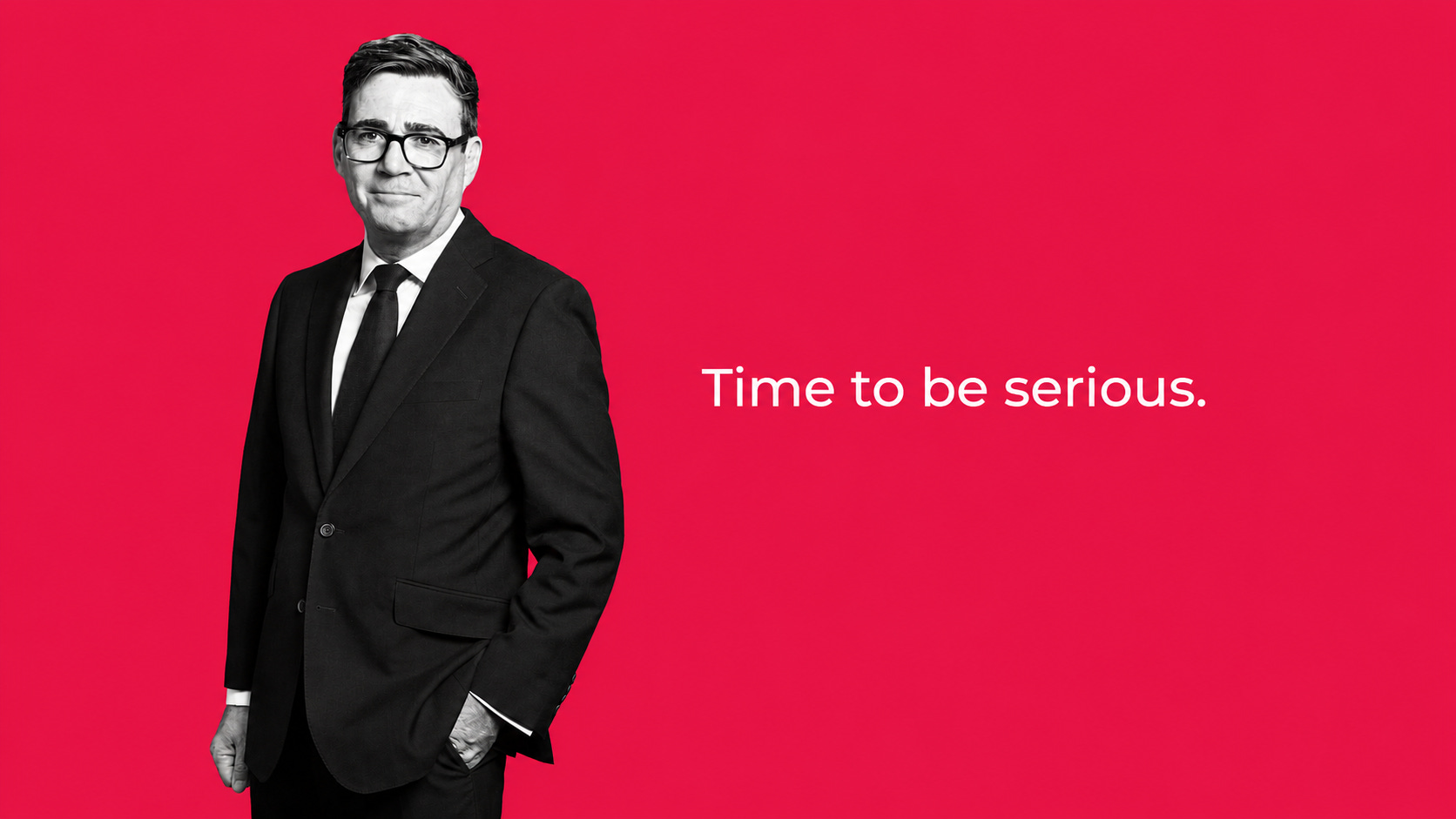
I really want to be optimistic about the start of the Andy Burnham era – but he’s not making it easy.
On paper, our new Prime Minister is a necessary correction for some of Keir Starmer’s most painful flaws. Unlike his predecessor, Burnham seems at ease in front of a camera. When he talks about his sincere love of football, he actually sounds like he means it.1
By wiping the slate clean with someone not tainted by the Ancien Régime, there’s an opportunity for the Labour Party to reset the story they are telling the electorate, now that Starmer’s huge victory in 2024 has turned sour. If the former Mayor of Manchester remains as popular as he is now, then Labour might stand a chance of winning a majority after the next election.
Most of the Labour people I speak to seem pretty happy about the change too. After months spent defending a terminally unpopular Prime Minister, one Labour-aligned commentator who regularly appears on TV told me the other day that the vibes felt good again.
However, as much as I would like to join in with the enthusiastic reception for the new PM, I can’t silence the nagging doubt in my mind – because almost everything Burnham has said and done since the Makerfield by-election has just seemed… not… great.
Take the cutesy line in his speech last Friday when he officially became Labour leader, saying that when a ‘Burnhamite’ walks into a bar, he wants the barman to say “Great to see you. We don’t like factional politics in here”, referencing the well-worn joke about Burnham lacking ideology.2
The problem is that as nice a platitude as that is, politics is about making choices, and there really are significant ideological differences between the different wings of the Labour Party. Perhaps the single most damaging criticism of Starmer was that he lacked ideology – which made his government feel rudderless.3 Burnham is essentially promising the same thing here, and I’m not confident a strategy of wishing much harder that everyone can just get along is going to cover the cracks.
One tangible manifestation of this over the last few weeks has been in the tension inherent in the definition of ‘Manchesterism’. Simultaneously the label has been used to describe the private-sector driven growth in Manchester under Burnham, and a return to more soft-left Labour values. In his speech, Burnham criticised the ‘failure’ of four decades of ‘neoliberalism’ – I’m not sure how to reconcile that with the forest of new skyscrapers around Deansgate.
However, this is not just about philosophy. Over the last few weeks, stories have been leaking out about what Burnham has planned once he takes office. Some of them will no doubt turn out to be nonsense – his inner-circle is reportedly pretty fluid, so some of the plans attributed to him may just be loud-mouthed would-be advisers bullshitting to journalists.
But what is striking is that in the steady trickle of specific ideas attributed to him is just how consistently bad they have been.
A question of policy
Let’s go through some of Burnham’s reported policy commitments.
A couple of weeks ago, the Guardian reported that Burnham is planning ‘rent freezes’, to help with the cost of living – essentially a form of rent control. The problem is that though superficially attractive, they don’t actually work. They discourage people from moving, the benefits are poorly targeted, and they just shift demand – and therefore pressure on property prices – around. They don’t reduce it. Plus controls are a huge disincentive for private developers and investors to actually build new housing.
Then, relatedly, on a slightly hazier note, Burnham reportedly plans to distance himself from the ‘Build Baby Build’ pledge that Starmer’s Housing Secretary Steve Reed publicly made his mantra, along with the Starmer-era rhetoric about backing the “builders, not the blockers”.
Instead Burnham apparently intends to take a more “collaborative” approach to house-building. And though there’s not much substance here – the story is more about a change of tone in the rhetoric – it does make me fear that Burnham won’t be as zealous on building, especially as “collaborative” invariably means giving in to the NIMBYs. It’s perhaps not a coincidence that during the by-election, Burnham suddenly decided that he opposes green belt development.
There are ominous signs in other policy areas too.
According to the FT, “Team Burnham” wants to slow down the introduction of driverless taxis in London, asking “What’s the point and who is it for?”. Which is, in my view, an utterly moronic position to take. Leaving aside the potential safety and transport system benefits of the technology, a more hostile posture would be a great way to kill one of Britain’s most promising start-up companies, Wayve. This is a firm that is currently valued at $8bn (a rare ‘unicorn’ company), and if successful could mean that a British company supplies the intelligence inside millions of cars worldwide – and gives us a toe in the AI future that is currently being built.
Then there is digital ID, which Burnham is apparently going to scrap because it has proven unpopular. I’ll obviously concede that the Starmer government’s rollout of the policy was not handled well – framing it as immigration control appears to have backfired. But the fundamental idea at the heart of digital ID, of giving everyone a consistent identifier so that government services can be more joined up is fundamentally one that is sound.
But, alas, Burnham will apparently reallocate resources from the policy to help people with the cost of living in some unspecified way instead – which feels like selling your car to help pay for your weekly grocery shop. It might reduce your shopping bill in the short term, but will ultimately make your life more difficult.
And finally, there is Burnham’s refusal to rule out a ‘wealth tax’, in an interview with Gary Lineker.
It’s hard to know exactly how to parse this, both because “refuse to rule out” is a classic politician phrase that can mean almost anything, but also because there’s a stupid version and a plausible version of a ‘wealth tax’.
I’ve written before about how I’m emotionally sympathetic, but the stupid version – taking a percentage of rich people’s assets every year – doesn’t make any sense. The short reason why is that it’s extremely hard to define and measure ‘wealth’, and even if we could it would require an impossible level of international cooperation to be implemented.
So I hope here he is only refusing to rule out the smarter, workable version – which is essentially fiddling around with capital gains tax, and calling it a ‘wealth tax’, like the one Wes Streeting proposed in May. This I do think is a good idea.
But honestly, the reason I mention it is because who the hell knows at this point what he’s thinking. I’m not sure even he does.
Taking trade-offs seriously
This brings me back to the importance of choices.
By all accounts, Burnham is very much a people-pleaser. He likes to be liked, which is both why he’s more charismatic on screen, and ideologically unmoored. It feels like he’ll say whatever is needed to placate whoever he is talking to.
And what worries me is that this doesn’t scream “serious person”.
I mean, look at the various spending commitments he has made in the last few weeks as he has positioned himself for Downing Street. He’s promised the biggest council-house building programme since the war, he wants to exert great public ‘control’ over water and other utilities.4 He wants to increase defence spending, filling the funding gap that caused John Healey to quit as Defence Secretary. And there are other vaguer promises about re-industrialisation and skills.
I don’t think any of these ideas are particularly bad in and of themselves.
But what I can’t work out is how he intends to pay for them, as they all have a price tag attached, and when he takes power he’ll be constrained by exactly the same fiscal situation that Keir Starmer and Rachel Reeves were. This means if he wants to spend more money, he’s going to have to choose between raising taxes, cutting spending elsewhere, or borrowing more money.
If there was a fourth option where he could press a magic button and get everything he has promised with none of the constraints, then surely his predecessor would have pressed it too.
And my fear is that the closest thing we do have to a magic button – economic growth – will be harder to achieve if he does all of the mad stuff he has promised above, like rent controls. So I worry that the ceiling on the best-case scenario for Burnham might be Starmerism, but with a principal who is even less willing to make political choices, who will cave to the whims of whichever faction of his party shouts the loudest at the same time.
Finally, this brings me to what I fear will be the punchline Burnham’s ascendancy.
One thing that is clear from the Starmer era is just how much the Labour Party hate the tough and often cruel line taken on immigration, such as with the plans to change Indefinite Leave To Remain and the “Island of Strangers” rhetoric. If only we could have Starmerism, but without the nasty stuff is a common thing you hear from Labour-ish people. I strongly agree that Blue Labour is not the answer.
Yet if the reporting is correct, more Blue Labour could be exactly what we’re getting. Burnham is reportedly planning to appoint Shabana Mahmood as his Chancellor, not because he wants to move away from the tough line on immigration, but because the Treasury would give her more control over cutting immigration, by putting her in charge of Britain’s entire economic model. Patrick Maguire characterises Burnham as a shift from the “London left”, not towards it.
Time to be serious
At this point, we obviously don’t know exactly how the Burnham era will play out. But it does feel as though the idea of Andy Burnham might turn out to be much more compelling than the actual Andy Burnham we’re going to get.
I hope I will be proven wrong. Because I want Andy Burnham to be successful – I want him to grow the economy, pursue abundance, and win the next election.
But if he’s going to be successful, he’s going to have to do more than placate his party and tell people what they want to hear. He’s going to have to show us that he is serious.
This is all the more inexplicably because Starmer actually loves football. But still he sounds like an alien describing a weird ritual that humanoids like to perform when talking about it.
A Blairite, a Brownite and Corbynite walk into a bar. “Hi Andy”, says the barman.
A stark illustration of the problem under Starmer is that without a clear governing ideology, it became very difficult for ministers and officials lower down the food-chain to intuit an answer to the question "What would Starmer do?”, when confronted with policy choice that had to be made. And given that Starmer himself didn’t seem too keen on micro-managing, it made for a pretty fatal combination.
Though he has been careful to avoid public ownership.
My main (only?) source of hope is that he gets devolution right. Otherwise I have low expectations, but this is a big enough deal that there is some grounds for optimism.
Unfortunately there has been a phoney war where in order to avoid a challenger, Burnhamism has been a fairly blank sheet to project upon. It has also felt like turf wars on policy as you discussed.
We're all waiting on 4pm on Monday to see what the first choices are from Burnham. And who will be first to shout "betrayal" as tradition demands.
To be prime minister is to choose and to lead. Whether this PLP is able to be led or whatever the furies will behead another PM? I don't have a scooby. He does have soft skills (an improvement) but is that enough.
The worst thing is that he kills all the various little projects that you, I and your readers like to pay for terrible macro policy like rent control.
A nation holds its breath