


Late on Saturday the 27th June, on the Old Kent Road in South London, a Waymo autonomous taxi collided with a motorbike.1
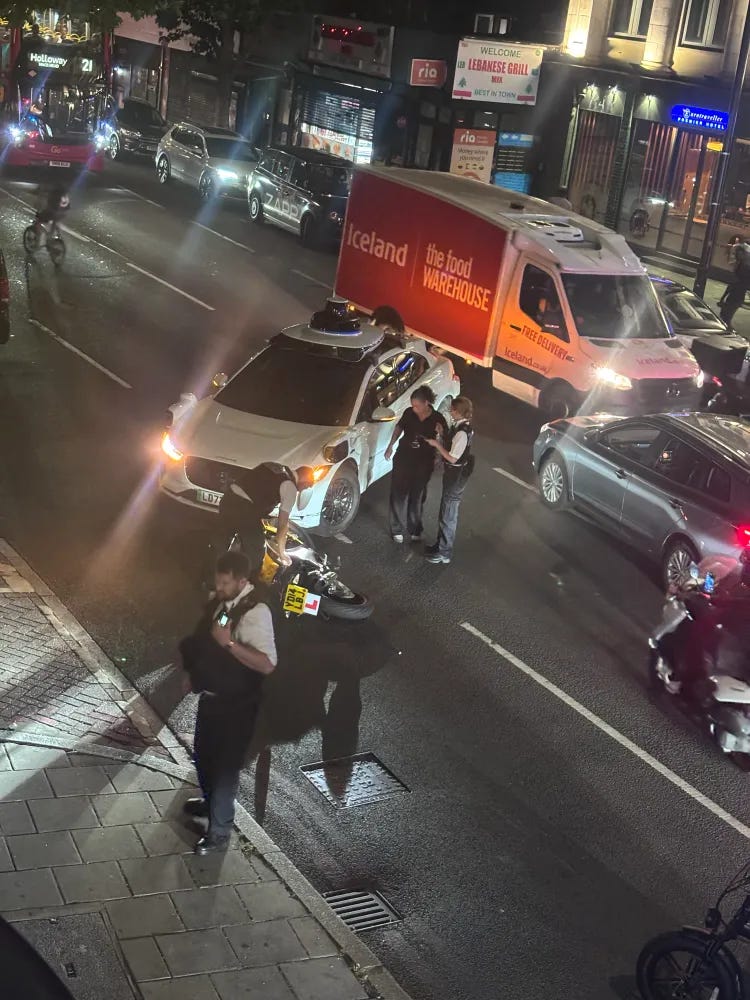
The Waymo was attempting to leave a queue of traffic on the main road to turn right into Marcia Street. The motorbike was heading in the opposite direction.
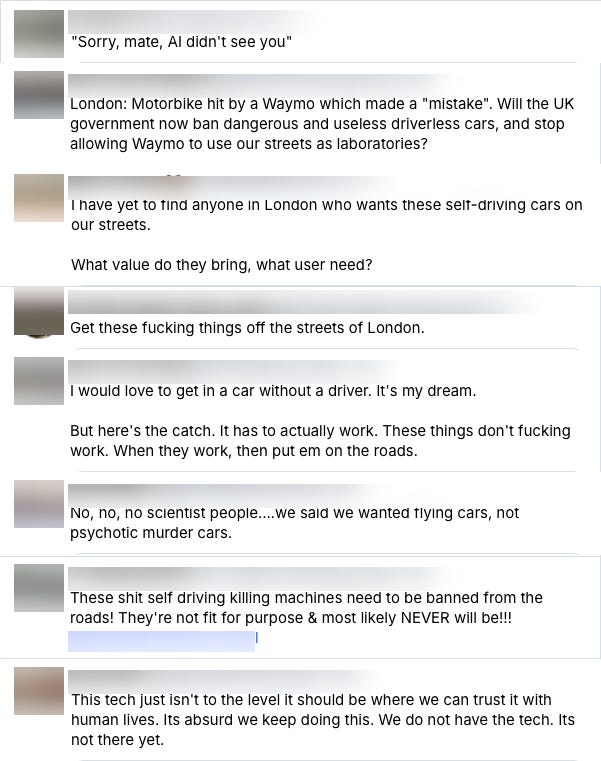
After it happened, Gautam Kambhampati posted the above photo to Bluesky, and the reaction was, well, exactly what you might expect. It was seen by many people as conclusive proof that autonomous vehicles are dangerous, and shouldn’t be allowed on Britain’s streets.
Here’s a representative sample of responses:
However, there was just one problem with drawing these conclusions. The car, it turns out, was not actually operating autonomously at all. In fact, the crash was the result of a human driving the Waymo, a modified Jaguar I-PACE, in manual mode, exactly like a normal car.
I know this because when I saw the photo, I reached out to the company to clarify the situation. Waymo told me that:
We can confirm that a Waymo vehicle was being manually operated by an autonomous specialist when it was involved in a low-speed collision with a motorcyclist. The motorcyclist was able to stand and walk immediately after the collision and declined ambulance transportation. We are fully cooperating with local authorities to review the incident.
I then posted the statement to Bluesky as a corrective to the narrative that was emerging, but there was still some scepticism about Waymo’s statement.
So to be clear, “autonomous specialist” is just the company’s euphemism for human drivers.2 And to add further context to the incident, I understand that the sequence of events was that the car was driving autonomously as it travelled along Old Kent Road, but when stopped in traffic the human driver chose to disengage the autonomous software and take full manual control, at which point they pulled out and hit the motorcyclist.
In other words, despite appearances, this wasn’t evidence at all that Waymo’s self-driving cars are dangerous. In fact, it’s the opposite – it’s another example of the risk of letting humans pilot heavy lumps of metal around our cities.
And it was important for another reason too. It meant that I got to win an argument on the internet.
I first posted about the Waymo incident before we knew the full story. I suggested that we didn’t yet know if the car was operating autonomously – and it turned out that in doing this, I was picking a fight with basically all of Bluesky. And what was striking was that the vast majority of the anti-autonomy arguments made in response to me were actually the result of some pretty sloppy thinking.
That’s why this week I’m going to follow in the grand tradition that was established by my post defending ‘industrial scale’ solar farms, and make this story all about me.
So let’s go through some of the things people said about autonomous vehicles and pick apart why they are wrong.
Autonomous cars aren’t safe

This was the most bizarre response I received, which was the claim that the evidence that autonomous cars are safer than humans is all just “marketing”.
The problem is that this claim has no basis in reality, because in mid-2026, autonomy is not just some hypothetical or highly experimental technology. Self-driving cars have already been invented, and are a thing that have existed in the world for some time.
For example, Waymo and other operators are currently running real robotaxi services in a number of American and Chinese cities. There are tens, if not hundreds, of thousands of autonomous journeys being taken every single day in the real world – and nobody is dying or getting hurt.
If anyone were, we’d be hearing about it on the news – but these services have been running for months, and in some cases years. That’s not to say that the robotaxi rollout has been completely without incident – Waymos and other autonomous cars have blocked traffic and caused other second-order problems. But in terms of keeping the passengers inside and the passengers around them alive? The safety record is remarkably good.
This is even the case for Tesla, the least risk-averse of the autonomous operators. When it first rolled out a supervised “full self-driving” (FSD) mode with private car owners, and likewise when it launched a driverless robotaxi service in Austin, Texas, there were reports of cars behaving erratically at times. But now the software appears to have matured to a point where it basically just works.
If you don’t believe me, type “Tesla” into YouTube, and you will find videos of extremely long and complicated journeys taken without human intervention.3
However, I’ll be generous. Let’s steelman the safety argument. As things stand, it is true that autonomous vehicles are still unproven on the streets of London. It’s common to hear people observe that though autonomous vehicles might work well on the wide highways of California, we don’t know if they’ll work on the unplanned, narrow streets of a European city.
There is at least some ambiguity here, though I’m pretty sceptical there’s really a problem at this point. This is partially because downtown San Francisco is still a pretty dense, complicated city, full of pedestrians, bikes and other hazards just like London.4
But it is also because Waymo’s British rival, the similarly named Wayve, seems to have demonstrably proven that autonomous driving in London is possible.5
If you want another indicator, back in April, Tesla launched FSD mode in the Netherlands – which is just as dense and squirly as Britain is. And the reason you probably didn’t know that unless you follow this stuff closely is because there hasn’t been a glut of news stories about the havoc and devastation that Tesla’s supervised autonomy software is unleashing on the country.6
In fact, according to the Dutch regulator, as of a couple of weeks ago 40,000 Teslas in the country had driven over 24 million kilometres without any serious incidents.
But if you want a more vivid illustration of this, here’s a twenty-minute video (admittedly from a couple of Tesla fanboys), putting FSD through its paces in a number of difficult scenarios which are very analogous to driving in the UK.
However, despite all this, I will concede that it is true that we still don’t know for sure whether or not autonomy will work in London. But you know what might be a good way to figure it out? How about if, say, we let autonomous vehicle companies like Waymo and Wayve test their vehicles on London’s streets with human drivers behind the wheel, to gather data and test their software’s effectiveness?
You know, like we’re doing.
Autonomy creates an America-style hellscape

There wasn’t a perfectly representative single post, but many responses to my post were essentially cycling and walking advocates making the urbanist critique of autonomy. This is basically the argument that autonomous cars won’t solve any problems, they’ll just add yet more congestion, making our cities worse for everyone. Why would we want to turn our streets into an American-style car-dominated hellscapes?
Emotionally, I’m very sympathetic to this concern, but I think the flaw with the argument is that it simply doesn’t have to follow that autonomous vehicles must mean car-dominated cities.
I mean, I also consider myself an urbanist. My favourite urban form is probably Amsterdam or Copenhagen.7 If I had my way, every city would be optimised for pedestrians and ‘active travel’, with wide cycle lanes, and restrictions on the number of cars allowed into the centre.
Where I differ with many people who think like this, though, is that I recognise that we’re still going to need cars, vans and lorries in some places and contexts.8 And if we can make these vehicles autonomous, that could save lives, improve mobility, and create economic growth – even if it doesn’t reduce congestion directly.9
But, you might then ask, what about our inner cities specifically? These are the places where robotaxis like Waymo, Wayve and Chinese operator Apollo Go want to operate. And the problem is that road space is a genuine zero-sum conflict between competing interests. So won’t the sheer convenience of these vehicles induce demand, and cause people to take even more car journeys, at the expense of buses and bikes – and therefore massively increase congestion?
If this was the case, this would be really bad. One example of why is the impact on buses. Average bus speeds in the capital are already getting slower with current technology, so, in theory, throwing hundreds of robotaxis into this mix could make bus services even worse and less attractive to passengers.
However, I simply do not think this is as inevitable as the urbanists fear – thanks to a little something called ‘regulation’.
In fact, I think that if we had a situation where a significant proportion of vehicles were part of autonomous fleets, it could create a much better equilibrium between the different modes of transport than we have now.
(Prepare yourself, I’m about to pitch what I think might be an original, novel policy idea.)
Take London. At the moment, the Mayor only has some relatively blunt controls over traffic. The biggest lever he has is the congestion charge, which is currently fixed at £18, with no hard cap on the total number of vehicles. If he wants fewer vehicles clogging London’s streets, he could raise the price to dissuade people, but it would be politically tricky, as it would upset and inconvenience thousands of individual motorists.
But in a robotaxi world, the political pain melts away, and there’s an enormous opportunity to manage traffic much more dynamically. For example, it would be easy to impose a hard cap on the number of robotaxis allowed into London using the power of market forces.
Just as New York has a fixed number of taxi ‘medallions’ that grant yellow cab drivers the right to operate in the city, London could auction robotaxi slots to operators like Waymo and Wayve,10 with a ceiling on the total number available. And just as we’re all used to surge pricing on Uber, the laws of supply and demand will set robotaxi prices.
This would essentially hand the Mayor a dial he can turn up and down that adjusts exactly how attractive robotaxis are compared to buses and other forms of transport. And it would be politically more straightforward to implement too. If the cap is raised it would directly inconvenience only a handful of large corporations, instead of thousands of human drivers, as would happen if such a system were to be tried today with human-driven private hire taxis.
Taken to its logical extent, I think such a system could be phenomenally effective. If the Mayor wants fewer robotaxis, he increases the medallion price. If he wants more, he reduces it. The market could even work in real time, responding to changes to congestion in London, and could work on a much more granular level than the congestion charge.
For example, late at night, more robotaxis could be allowed in. If a bridge is closed and traffic snarls up? Then the price could rise, sending robotaxis streaming out of the city to free up the roads.11
So, this is all to say that the urbanists should not confuse the technology with the outcome. The congestion argument is mostly a red herring. Robotaxis don’t make congestion inevitable, and we have the power to shape outcomes. And managed effectively, robotaxis will actually make it easier for us to have the best of both worlds.
Who is liable if there’s a crash?
Another pushback was about responsibility. If a normal car hits someone, the driver will face the consequences – they might lose their licence, or even face prison. But who is to blame if a robotaxi hits someone?
For a start, the 2024 Autonomous Vehicles Act has already figured this out in terms of legal liability and insurance and so on. In short, instead of responsibility falling on the person inside the autonomous vehicle, it falls on the companies behind it, such as the software developer or the licensed operator.
But more broadly, I think this is a pretty strange thing to worry about, because there are many situations where harm can be caused by companies or organisations, rather than individuals.
For example, what would happen if a drug company were to produce a new medicine that accidentally killed people? Or what if a new model of car had malfunctioning seatbelts that didn’t keep people safe in a crash?
The answer is that we have well-developed legal and regulatory mechanisms for dealing with them. Regulators can impose fines or withdraw operating licences. In some cases, individuals inside a company can face criminal sanctions.
And sure, we can argue about whether or not these punishments are harsh enough, or how consistently the rules are applied, but… well, that's politics. And I’m just not sure what would make autonomous vehicles uniquely different in this respect.
We can’t trust Big Tech


The most surprising response to my posting came from an elected politician. Caroline Russell is a London Assembly Member, the leader of the Green group and Chair of the Assembly’s Transport Committee.
And her take was… that the human wasn’t at fault even though they were the one driving? Which is certainly an interesting flip on the liability question.
Still, this wasn’t the most frustrating response, as even though I had shared the statement from Waymo, many respondents were clearly desperate to find something about the incident to be mad about, so they resorted to speculation that, basically, Waymo had lied to me.
And this is where the issue becomes genuinely a bit irreconcilable.

I mean, maybe I’m too trusting of Big Tech, because I’m a credulous establishment shill in my old age, but I think it’s unlikely that Waymo would lie about the details to me.
First, lying to journalists is always a bad idea. If the lie is discovered, they can quite easily blow things up into a scandal. Second, the robotaxi trials are supervised by TfL, and traffic accidents are often investigated by the police. Would it really be good for Waymo’s future business if a more official investigation later discovered the company was covering up an incident where a motorcyclist was hurt because of autonomous software?
I can totally believe that the company might use slippery language, as that’s what all corporate PR people do. But Waymo has provided enough basic facts to basically box in an account of what has happened. We know where the car was going, we know when the autonomous software was disengaged, and we know that it was the human’s choice to disengage it.
And if you can’t accept this, and need to rely on a conspiracy explanation instead, I’m not sure what to say.
Taking autonomy seriously
Over the last ten years, there has been an average of around 106 traffic deaths every year in London alone. The numbers are pretty consistent year on year.
But it no longer has to be this way. We have invented the technology that could significantly reduce this number. At some point in the next few years, the safety question is going to flip, and we’re going to ask why we’re allowing anyone to drive the old-fashioned way, given how demonstrably proven autonomous vehicles are.
And that’s why I’ve spent this post settling scores with randos on the internet. Because now that autonomy is arriving, there are real questions ahead about how to manage the transition, and balance the trade-offs this new capability presents.
The congestion issue I describe above is a good example of this. It won’t be a problem if we plan ahead. It could actually work out better.
There are other real issues too. There’s the reality that London currently employs thousands of taxi and private hire drivers. We’ll need to figure out how to manage the technological transition fairly, so that we can take advantage of the new technology, while taking care of the people displaced.
And there are also questions around digital sovereignty. My friend Tym wrote recently in my newsletter about how Chinese robotaxis conceivably present new security challenges that policy-makers will have to grapple with.
If we actually want to build a future that works, then it means being serious, and not just reflexively cynical, in a hazy, reality-denying way, because it is more comfortable to simply assume the new thing is bad.
I think it’s now obvious that autonomous cars are not a false dawn. They have been invented. They work effectively. They can drive more safely than humans. So let’s take advantage of them.
If you enjoy deep dives on politics, policy, tech, infrastructure and media, with some slightly bitter score-settling on the side, then make sure to subscribe (for free) to my newsletter to get more of this.
Waymo’s autonomous cars are currently being tested in London, ahead of a planned rollout of an Uber-style service later this year. To prepare, the company is driving its cars around the capital with human drivers behind the wheel, to build a detailed 3D maps of the area Waymo intends to serve, to collect training data for the company’s self-driving model, and to test the autonomous driving software on British roads.
I guess this is like how Asda doesn’t have staff, it has “colleagues”, or how Disney doesn’t have an engineering department, it has “imagineers”.
At this point autonomous car nerds will get mad at me for not getting into the details of Level 2 vs Level 4 etc etc. But my point here is that the autonomous systems work in the form that they have been made available to consumers. FSD Level 2 works well with a human behind the wheel supervising, Waymo and Tesla robotaxis work at Level 4, driving themselves without a human in the driving seat.
If my experience of San Francisco is any indication, I imagine Waymo must have tonnes of training data on how to avoid drug-addicts lying unconscious in the street.
This footnote is to acknowledge the person in the comments who is going to point out that Wayve (and Tesla) use a slightly different model of autonomy to Waymo. But this is already long enough without getting into LIDAR sensors and end-to-end training vs rules-based models.
Dutch regulatory approval has actually made it possible to drive ‘FSD’ in I think five European countries, because of mutual recognition.
I think it’s likely that autonomy will reduce congestion as fewer people will need to own private cars, and it will eventually make the overall pool of car traffic work more efficiently, but this is an argument for another day.
Wayve’s vehicles will actually be operating inside Uber, but you’ll see my point here.
I think the the best mechanism to set the price would be for the Mayor to impose a dynamic tax on new robotaxi journeys, like how Uber charges a base price now, and then additional fees per mile. So the base fee for these services would just incorporate the “Mayoral spot price”, or whatever we’d call it.
The real benefits I see of this technology are out in more rural areas, rather than inner cities. The possibilities for small-scale, local public transport networks where running a bus with a human driver is currently infeasible. Ride hailing on flexible 'routes' between villages. It oculd save village pubs if you could reliably get a late-night taxi home for a reasonable price!
I think a big use of autonomous vehicles is to transport those who are either too old or too young to drive.
Within London, black cabs have filled this need. But outside the city, it usually requires friend or family to go and pick them up. The school run could be transformed.
Potential for an overall reduction in traffic?