


POD! On YIMBY Pod this week, why Remainers and YIMBYs could soon be at loggerheads, how HS2 and Wendover Council found the stupidest solution to a long-running disagreement, and we speak to Phil Tinline about why Britain needs a new ‘Theory of Power’. Listen here, or wherever you get your pods.
The strange thing about politicians is that they sometimes seem afraid to use their power.
Take Steve Reed, the Housing Secretary, for example. He took on the role and very publicly proclaimed with huge fanfare that he would “build, baby, build”, even sporting the slogan on a hat.
To be fair to him, he has overseen several steps in this direction, as his department has announced a series of incremental reforms.
For example, councils will soon have to report any sufficiently large proposed developments (typically 150+ homes) up to Whitehall. This is so that his department has greater visibility over projects that could conceivably be “called-in”, so that the minister, and not the local council, is the final decision-maker on the planning application.
It’s a great idea, as the government in Westminster will more likely act in the national interest, and approve projects that make a dent in the housing crisis, instead of fold in the face of opposition from NIMBY homeowners upset about building in their local area.
But Steve Reed has yet to show us just how powerful he really is. If he wanted, he could simply act far more aggressively. Why not instruct civil servants to go out and look for large developments, and call-in them by default?

As Tim Leunig pointed out on YIMBY Pod, Reed could go full DOGE, and simply call-in hundreds of proposed developments and sign them all off with little more than the stroke of a pen. That would certainly get Britain building more quickly.1
However, even though he could do this, he hasn’t, and the reason why is obvious. If the minister aggressively inserts himself into the planning process, it requires taking a political risk. Should anything go wrong, his fingerprints will be on the decision, and it will be politically damaging to him.
Let’s be real, if you’ve read this far, you’ll like the sort of nerdy things I write, so make sure you’re subscribed (for free) to get more like this in your inbox, and to support my writing.
Outsourcing responsibility
Fear of their own power is why politicians often have strong incentives not to do anything, and it’s why sometimes, decisions are considered so politically sensitive that they are outsourced to an outside or arm’s-length body. Why take the damage, when faceless bureaucrats can make the big decisions instead?
Sometimes this approach works. Bank of England independence seems to be successful. The Chancellor sets a high-level inflation target, but it is the Bank’s Monetary Policy Committee that makes the final decision on where to set interest rates.
But this outsourcing can also go very wrong.
An obvious example is the creation of NHS England in 2012. In principle, you can see the argument for it: It put day-to-day operations and control over budgets and so on, into the hands of doctors and health ‘experts’, rather than politicians. It certainly sounds appealing, as who doesn’t like experts? And in theory, it is a layer of insulation between the politicians and anything going catastrophically wrong.
But the flip-side of outsourcing is that it means that when the politicians actually want something specific, they have no direct way to issue an order and make it happen.
That’s why the decision by Keir Starmer to abolish NHS England, and bring its functions back into the Department of Health and Social Care, in principle, makes a lot of sense. It puts the nationalised health service, which represents an insane proportion of public spending, back under the control of the people elected to make decisions on how the system should work.
And this isn’t a good idea just because of high-minded ideas about democratic control, but because it makes it possible to align the bureaucracy around a specific cross-government strategy. Which in the case of the NHS means that once NHS England has been reabsorbed, it will be easier for the health secretary to actually do stuff to actually deliver the ten-year NHS plan they were elected on.
However, NHS England is far from the only case when outsourcing decisions goes wrong. And this brings me back to planning, as there’s another arm’s-length body that is out of alignment with the government’s strategy, and making it harder for the government to actually govern.
I’m talking, of course, about Natural England – and what this is piece is really about is how it’s time to abolish it.
The problem with Natural England
Natural England (NE) is the government’s all-purpose arm’s-length body for handling nature and countryside stuff. Its current form was only created in 2006, and today it is responsible for a wide range of functions, from regulating Sites of Special Scientific Interest (SSSI), to running land management and nature recovery schemes.
Most relevantly for this piece though, Natural England also plays a significant role in the planning system. It’s a statutory consultee during the planning process in many circumstances, such as when proposed buildings are either inside, or likely to affect, SSSIs and other protected sites.
This means that developers have a legal obligation to consult the agency when building, and NE gets to wade in on planning applications. And though it doesn’t have an explicit veto over what gets built, its support or disapproval clearly holds significant weight with the people who do make the final decisions, and in many cases, it’s opinions function as an de facto veto.
This is because, primarily, there are cases when NE’s opinion does hold legal power, such as with SSSIs or habitats regulation. In theory, this can be overruled. Councillors or the government just has to explicitly spell out why they have given material consideration to NE’s points, but disagree.
But in practice, disagreeing can create a legal nightmare as it opens councils or government to legal challenge, dragging them into a judicial review nightmare. So what usually happens is that plans are put on ice, and authorities try to work around Natural England’s declarations.
One example of this is the famous case of the Ebbsfleet ‘jumping spiders’. I’ve written about this before, but long story short, a dense new town centre was planned around Ebbsfleet International station in North Kent. It was to be the centrepiece of a new town of upwards of 15,000 homes, which would be just an 18-minute train journey from London. But in 2021, NE declared half the site to be an SSSI.
And what this meant in practice was that even though the spiders the SSSI was designed to protect are not actually anywhere near the station, five years on nothing has been built. Today, the area around the station is still fields and car parks, rather than homes, amenities and offices.
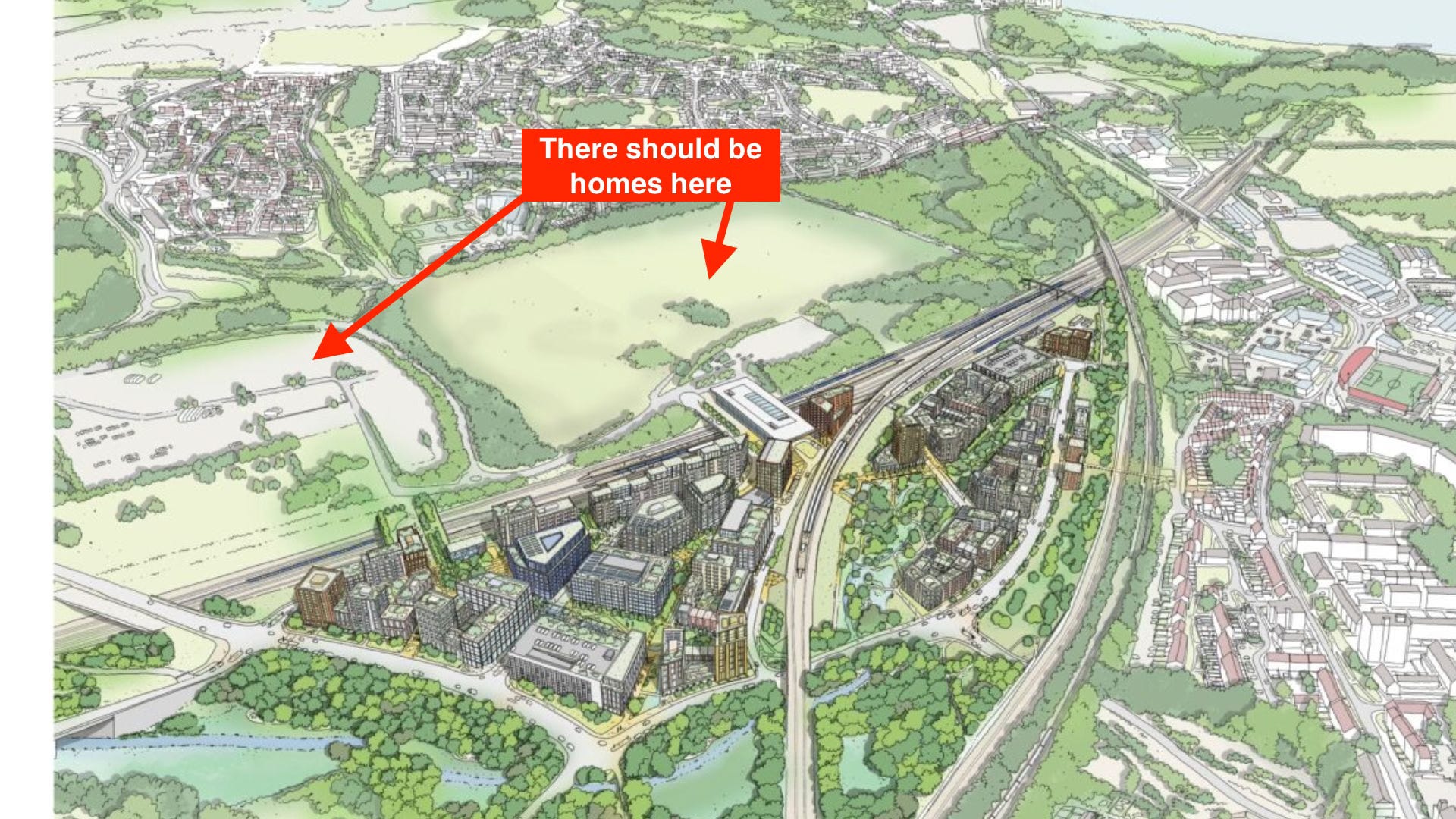
Another notable example of Natural England’s role is in a development called One Horton Heath in Eastleigh, Hampshire. This was a pretty significant development – up to 2,500 homes. At the time of writing, it is finally under construction, but the road to get there was made more difficult by NE, which raised objections in both 2022 and 2024.
The first was regarding nutrient neutrality, as the council had to demonstrate they were offsetting additional nitrogen and phosphorus draining into the Solent. This is a particular bête noire that I won’t get into now – not least because, in theory, it’s been addressed by the the Planning and Infrastructure Act, which was passed at the end of last year.
The stranger objection though, in my view, is the requirements around ‘Suitable Alternative Natural Greenspace’ (SANG) that NE refused to sign off on.
In this case, NE made the argument that because the new homes would be 12 miles away from the New Forest National Park, residents may wish to visit it – which would harm the New Forest.
So what’s the solution? According to Natural England’s guidelines, it is to build three, new, large, on-site recreational areas suitable for minimum walks of a weirdly specific 2.3km in length.2
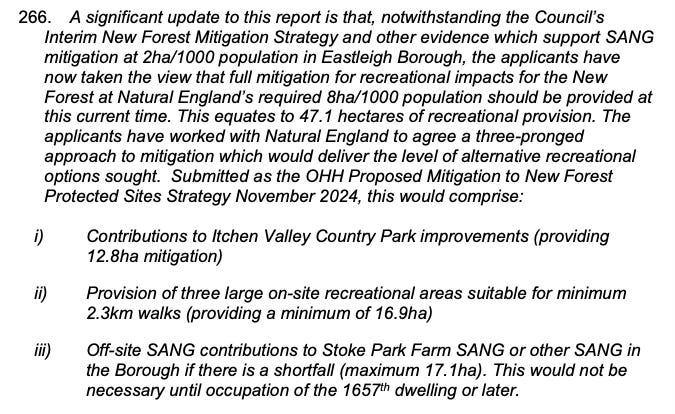
And sure, this doesn’t sound too bad. In isolation, none of these requirements sound like bad things to want. More green-space sounds nice! But the added requirements ultimately pile up, adding to the mountains of bureaucracy, and endless delays, before shovels hit the ground. And if the council were to try to skip the paperwork, it would leave them open to judicial review.
A disapproving look
This isn’t the only reason I think Natural England isn’t working. It also plays another, less carefully defined role in the planning process.
Specifically, before plans are formally submitted to NE for scrutiny, the agency also plays more of an advisory role. On paper, this makes sense – rather than have NE shoot down a planning application as it reaches its final stages, it seems much more sensible to work with them to help shape plans to begin with.
But I fear this in itself could have an adverse effect on plans, with mitigations ratcheting up the cost of building and making projects harder to deliver, for the same reason that a doctor is never going to actively recommend eating cake or getting drunk, even though they might be enjoyable things to do.
Here’s how the 2006 legislation described the purpose of the agency:
“Natural England's general purpose is to ensure that the natural environment is conserved, enhanced and managed for the benefit of present and future generations, thereby contributing to sustainable development.”
So no wonder NE is… doing everything it can to protect nature. That’s literally its entire deal, by design.
It’s like how regardless of the nice adverts featuring solar panels, BP’s aim is ultimately to maximise shareholder value. And it’s like how regardless of the role you want him to play, Taika Waititi is going to do that same tiresome schtick in every film.
So letting Natural England play such an outsized role in planning simply doesn’t make sense for the same reason that we wouldn’t task HMRC with setting the rate of tax – there are trade-offs, and weighing them is a job for politicians.3
This is why the agency should be abolished, or at least significantly reformed.4 If the job of weighing the environmental benefits of a project was handed explicitly to the Environment Secretary, it would mean that a politician has the final say in what is, invariably a difficult balancing of interests.
And sure, this would mean that decisions on whether to approve or disapprove on environmental grounds become more vulnerable to political pressure. But that’s the entire point.
If the elected government decides that a new town centre, next to a sizeable railway station mere minutes outside London is more important than protecting some spiders which aren’t even there, then it should happen.
And if the government has set the strategic objective to unleash a wave of construction to grow the economy and provide homes for people to live in, that could actually happen too.
To be clear, making this switch doesn’t always mean that development would always win. If Zack Polanski or Richard Tice was the Minister making the decision – both plausible outcomes of the next election5 – then it would be disastrous for development. But crucially, it wouldn’t be an outsourced decision. It would be politicians making terrible decisions that they’d have to own, with no cosplay quasi-judicial arm’s-length body to hide behind.
So let’s abolish Natural England, or at least significantly retool it. You can’t take the politics out of politics – so let’s stop pretending there’s no trade-offs, give politicians the power to actually make things happen – and make them own the consequences of their decisions.
If you read this far, you must like my stuff, so make sure to subscribe to get more like this direct to your inbox.
You might also like this piece I wrote a little while ago about something we can do to, er, better protect nature.
I think he should do it en masse, in an elaborate stadium-based signing ceremony, like Donald Trump with his executive orders after taking the oath of office.
For some reason this makes me think of the scene in Moneyball, where Brad Pitt explains that even if they can’t get a star player (the New Forest), they can get the equivalent by hiring three players who add up to the equivalent value of the star.
The counter to the Bank of England regulatory independence argument here is that Bank of England independence is working as intended – it gives the markets confidence. If the Monetary Policy Committee were making crazy decisions that led to outcomes at odds with what the government desires, it’d be absolutely fair enough to change this arrangement. (Similarly, lots of non-mad people think we should reform the OBR as it bakes in a pretty blinkered austerity-driven view of the government finances, but it’s awkward to say so because it makes you sound mad and fiscally irresponsible.)
Despite my dramatic headline, there is probably still the need for an agency to handle day-to-day stuff, like enforcing pollution standards and collecting data. It just shouldn’t be doing the political stuff!
Any coalition negotiation between Labour and the Greens is going to result in a Green MP getting the environment brief, because obviously. I just hope Labour’s negotiators can keep them away from energy.
Fully agree - and good to see the pro-politics, quango-sceptic movement gaining ground on the left!
Maybe we need to have a finite quantity of land that can be given SSSI or protected status. If Natural England find that a piece of land is a rare habitat, then they'll have to de-protect some other piece of land elsewhere in the country. Having protected land for important species is important for preserving habitat, but that has to be balanced with a growing human population.
The minister can set the km2 land area and then NE can work out what can and cannot be protected.
I'd go further and turn those protected lands into their own special zone in a zoning system, that way nothing can be built there. Outside of those zones, NE wouldn't even get consulted.