



POD! On YIMBY Pod this week, why it’s your patriotic duty to run your air conditioner, why phone signal is so bad in Britain, and the NIMBYs taking on… a cancer hospital. Listen here, or wherever you get your pods.
It is likely that this summer Britain will achieve a major decarbonisation milestone.
If the sun shines brightly, the wind blows fast, and demand on the grid is low, it is possible that the national grid will briefly be entirely free of fossil fuels.
And it will probably happen. Just yesterday, in fact, we nearly did it. At 11:30am, the share of gas fell to just 2%. So on a hot, windy, weekend afternoon in July, when factories are powered down and shops have closed, it could finally be the moment.
When it happens, it should be a moment we celebrate. Just like how Britain moved from a grid in the 1980s that was mostly powered by coal, to a grid today without a single coal power station, it will be another tangible sign that we really can build a better world.
And the word “build” there is important.
When the grid reaches net zero – at first momentarily, and in time permanently1 – it will be because we have transformed the built environment of the United Kingdom, and transformed our energy system by building new infrastructure.
But there is still a long way to go. Hitting net zero when circumstances are perfect is one thing, but we still need to build much more, so that we don’t need to fire up the gas generators when the sun isn’t shining.
And the only way we are going to do this is if we generate green energy at industrial scale. Think vast wind farms both at sea and on land, solar farms blanketing swathes of the countryside, and nuclear reactors to provide baseload power for when the sun doesn’t shine and the wind does not blow. We’ll also need new pylons and other energy transmission infrastructure to move this new, clean energy around the country.
So it will be an enormous challenge, but – perhaps surprisingly – so far, it is not one at which Britain is failing. Around the country, utility-scale renewable projects are planned or are under construction, incrementally adding to Britain’s supply of green energy.
East Pye Solar in Norfolk is one such project. It’s a solar farm that will be chained across ten sites close to the village of Long Stratton, and the 500 megawatt (MW) project could one day generate enough clean energy to power 115,000 homes. It is so important that it has been designated a Nationally Significant Infrastructure Project by the government, and it’s exactly what we need to be building, if we are serious about decarbonising the grid.
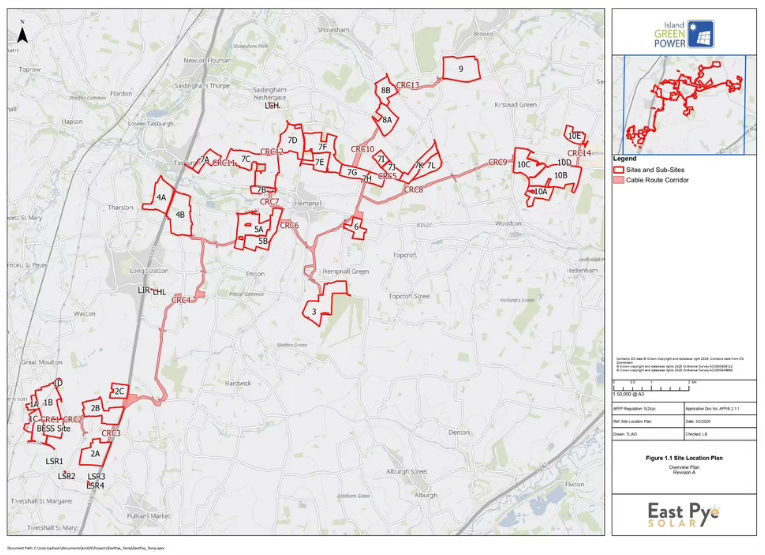
Sadly though, it seems that not everyone is quite so serious about decarbonising, and there is opposition to the project from politicians of all stripes.
For example, predictably Reform deputy leader Richard Tice, who splits his time between Dubai, London, and hopefully his constituency of Boston and Skegness, has criticised the development, because he’s the absolute worst.
But there is also opposition from one party that might be more surprising. The party that you might assume would be in favour of renewable energy, because until recently it was the party’s entire schtick.
I’m talking, of course, about the Green Party.
The leader of the Green Group on Norfolk County Council, Catherine Rowett, expressed her opposition to the scheme, telling the BBC that:
“The basic thing is that these shocking schemes are [proposed by] foreign investors looking to make a profit out of our ridiculous energy prices,” said Rowett.
“It’s a huge profit margin for those who can get some renewable energy from our sunshine and take the profits offshore.”
In other words, she has searched around and in an impressive feat of mental gymnastics, she has managed to find a rationale to oppose a large solar development in her proverbial backyard.
It’s all about me
I’m now going to make this all about me.
When I saw the BBC story linked above, because I can’t help myself I posted about it, writing that “I see the Greens are opposing (checks notes) solar power now”.2
Let’s just say the reaction was… mixed. It wasn’t a pile-on – most of the feedback was either polite or at least as equivalently rude as I was, and you know, you shouldn’t dish it out if you can’t take it. So as my mentions filled up, I attempted to exercise good epistemological hygiene, by only blocking the truly abusive people, who invariably had anime avatars.
Anyway, seeing the Green supporters’ pushback was strangely interesting. It was striking just how many people were willing to drive an intellectual Zamboni behind Rowett, and attempt to justify or further explain her opposition to building solar, without conceding that she was, as I saw it, opposing the construction of solar energy.
But as open-minded as I like to think I am to changing my mind, basically all of the arguments against constructing the solar farm are bad. So I thought that rather than go toe-to-toe on Bluesky, I’d write a proper response here and dig into the real arguments that were made against building. And for ease, I’ve sorted them into four core arguments, and included a representative response that makes the case.
So let’s go through them and get mad.
Argument 1: Put solar panels on buildings instead

It’s a seductive argument. Instead of rows of solar panels in a field, why can’t we put them on top of buildings instead?
Now, I’m all for rooftop solar where it’s possible. In fact, a couple of weeks ago I signed a contract to have solar panels installed on my own home because, well, have you seen the news?
But rooftops are not a magic bullet that avoids the need for difficult choices. The reason we’re going to need large solar farms is because we can only generate the energy we need, and we can only do it affordably, if we do it at scale.
Let’s start with cost. Laying panels out in rows in a field is just obviously much cheaper than retrofitting existing buildings, for the same reason that building on a greenfield site is cheaper than brownfield. There’s no need to come up with a bespoke installation, put up scaffolding, or work around the existing built environment. And similarly, there’s no need to fight thousands of individual planning battles,3 or arrange thousands of separate new grid connections.
However, I think the bigger problem is nobody realises just how many buildings we’d need to transform.
Let’s say that like East Pye, we wanted to generate 500MW for 115,000 homes, and let’s imagine the best case scenario for rooftop solar: we’re not putting panels on a historic building, or somewhere architecturally tricky in the centre of a city.
Instead, we’re putting panels on top of a boring, massive metal box, like the 2-million-square-foot Amazon warehouse in Tilbury, Essex. It’s equivalent in size to 28 football pitches, and the roof is relatively flat, so this should be the easiest install in the world.
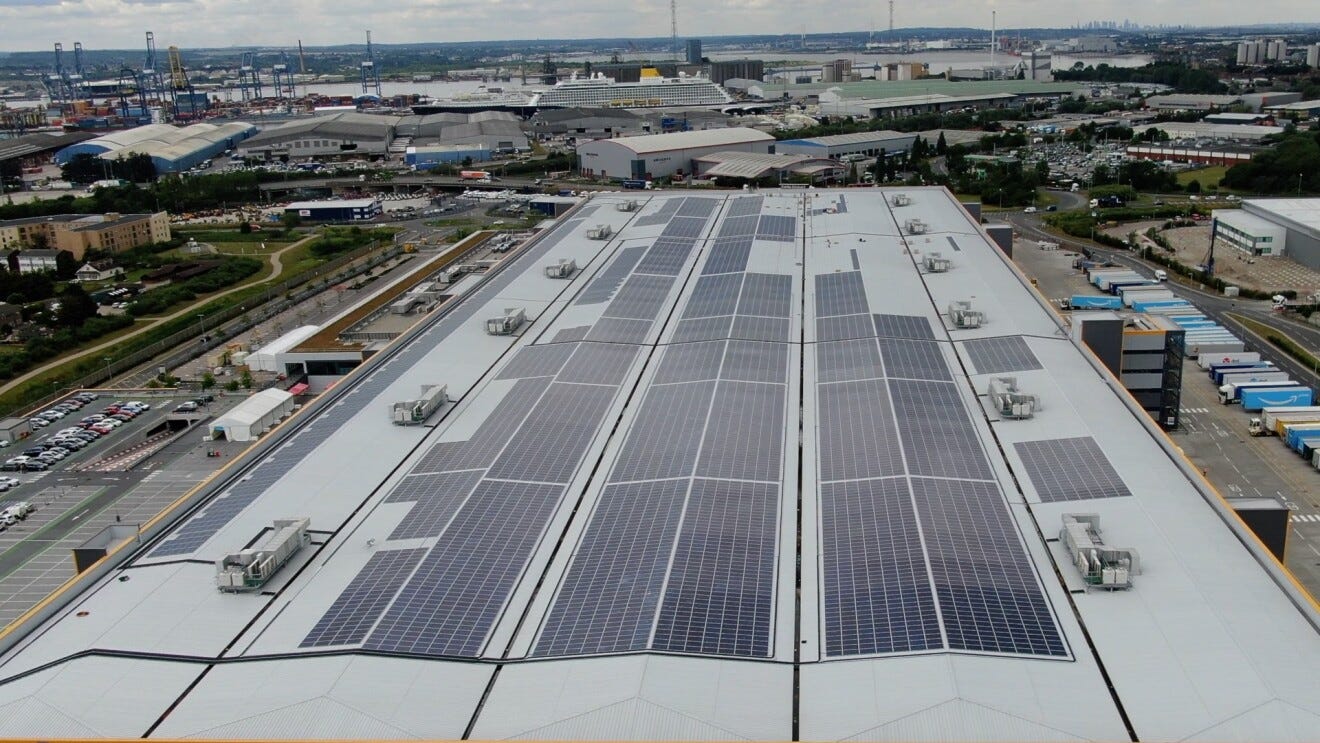
Except... in 2020, Amazon proudly announced that it had installed 11,500 panels onto the warehouse in its largest single solar deployment in Europe, and yet despite the enormous size, total generation capacity was just 3.4MW, or equivalent to 700 homes.
That means to generate the equivalent energy to East Pye, you’d need over 147 Amazon warehouses.4
And again, this is the best case scenario. In fact, this warehouse is the largest single warehouse in the UK. And this back of the envelope calculation doesn’t take into account the complexities of retrofitting panels on different types of buildings in the real world.
So I think this basically illustrates why achieving utility-scale solar with just rooftop solar is largely a fantasy. And given costs are constrained – because money is not infinite – if you want to deploy solar and get the most bang for your buck, then large solar farms need to be a significant part of the solution.
Argument 2: Large solar farms should be community owned and the problem is private equity
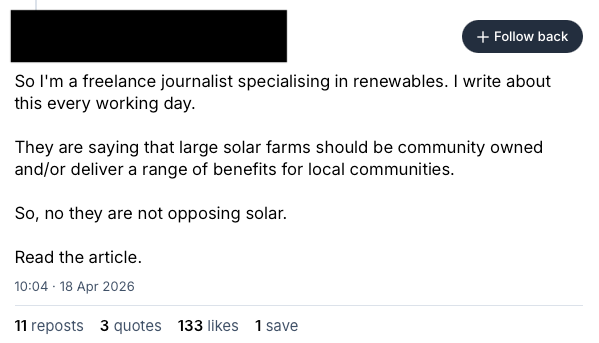
On an emotional level, I can understand the appeal of ‘community ownership’ of solar assets. It implies that the energy generated will pay back to the local area, just as putting solar panels on your house means you can sell energy back to the grid.
The only problem is, well, there’s absolutely nothing practical about building solar in this way.
The term is used pretty loosely, but as far as I can tell, the largest solar farm in Britain that we can reasonably call ‘community-owned’ is currently Derrill Water in Devon. It only has a capacity of 42MW – less than a tenth of what East Pye will manage. And even there, the model is that only 10% of the shares are reserved for local residents and local businesses to buy – with the remaining 90% sold on the open market just like normal commercial developments.
And for context, the second largest community-owned site I could find is Ray Valley in Oxfordshire – which generates only 19.2MW. The list rapidly shrinks from there, with most other community-owned facilities weighing in at around 5MW, a one hundredth the size of East Pye.
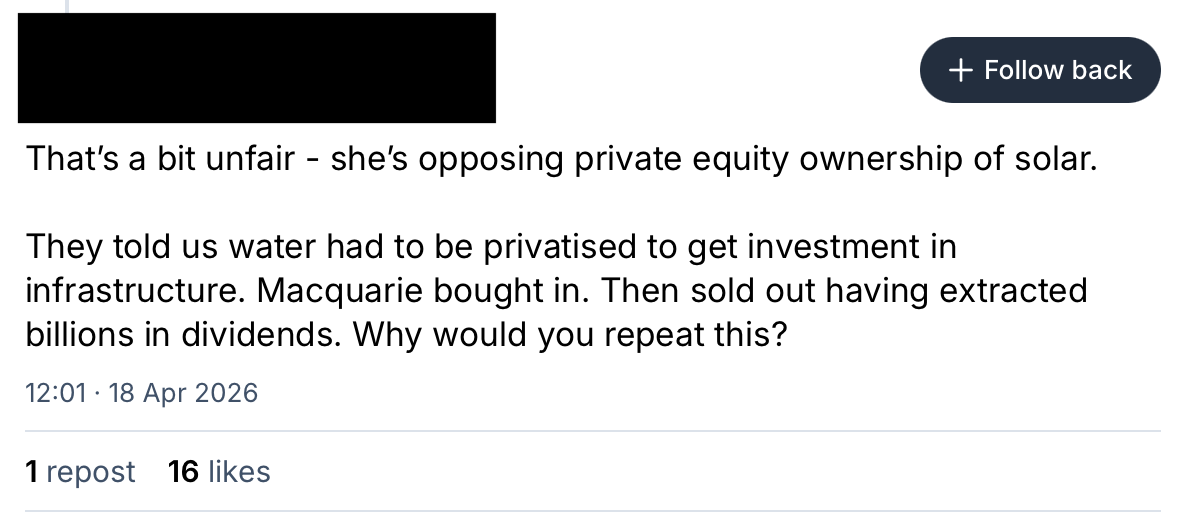
So I suspect that in reality, if we did insist on a ‘community’ owned East Pye, it would effectively just mean that no solar gets built. And at risk of sounding like a neoliberal shill in my old age, this sort of illustrates why private equity firms like East Pye’s owner, Macquarie, are often involved in solar deployments – because they can do something ‘communities’ cannot. They can raise the cash to build the solar farm quickly, and because they own other things around the country (or world), they are better hedged against any one project failing.5
By contrast, if local investors, or even a local government like Norfolk County Council, were to put all of their spare cash into a solar farm, and it were to fail for some reason,6 locals would be totally out of pocket.
Finally on this argument, there is the very specific point that with East Pye it isn’t just any private equity company involved. Macquarie is the Australian multinational that until 2017 owned and arguably mismanaged Thames Water.
Surely I’m not going to defend that company getting involved?
I mean, I’m not looking to specifically hold a candle for Macquarie here, but it does seem like there is a significant difference between a company putting up the cash to build a new solar farm, and taking ownership of an existing, decaying asset like Thames Water. Not least because there is less that can go wrong, as less electricity can’t leak like water can and worst case scenario, the new thing doesn’t get built, instead of the existing utility getting worse. So honestly it doesn’t bother me that much.7
Argument 3: Farmland is best kept for food production

One common argument against building new houses on greenfield sites is that whatever is planned is taking away valuable farmland. It is usually only an absolutely massive coincidence that the proposed development is close to the opponent’s own home.
So it is fun to see the argument deployed here, against a solar farm. As much like how people don’t seem to understand the scale required for a renewable grid (see above), I don’t think people quite appreciate the unnatural reality of farming.
Let’s start with biodiversity. As my YIMBY Pod co-host Martin likes to point out, farming isn’t great for biodiversity! In fact, the entire point of a farm is to plant rows of the same crops as a monoculture. And even though fields might appear natural, they are basically just as man-made as our cities. That’s why George Monbiot-types have tried to make ‘rewilding’ a thing. So it really isn’t clear to me why replacing crops with solar panels mounted on frames is particularly different here, not least because solar farms tend to place panels on frames on top of grass fields anyway.8
But what about the food production point above? I’m not sure if the respondent here is making an argument that it’s better to grow locally for environmental reasons, or an argument about food security.
If it’s the former, then we can immediately discount it. There isn’t a link between the distance from farm-to-table and emissions, because we live in a world of industrial production and container ships. Hannah Ritchie wrote a great piece about it, arguing that if you really care about carbon impact, it’s more important to think about what you eat. So if you actually care about the carbon impact of your food, you should become a vegetarian or vegan.9
But what if the food argument is more about security? Well, the reality is that Britain has not been self-sufficient for literally hundreds of years. By 1870, we were only 60% self-sufficient in terms of food, and we are only 65% self-sufficient today.10
So I guess I’m left wondering, is this really a problem? Unlike energy (more on that in a moment), food imports are not subject to any particular bottlenecks like the Strait of Hormuz, and the overwhelming majority of our imports come from 27 of our closest democratic allies in the European Union.
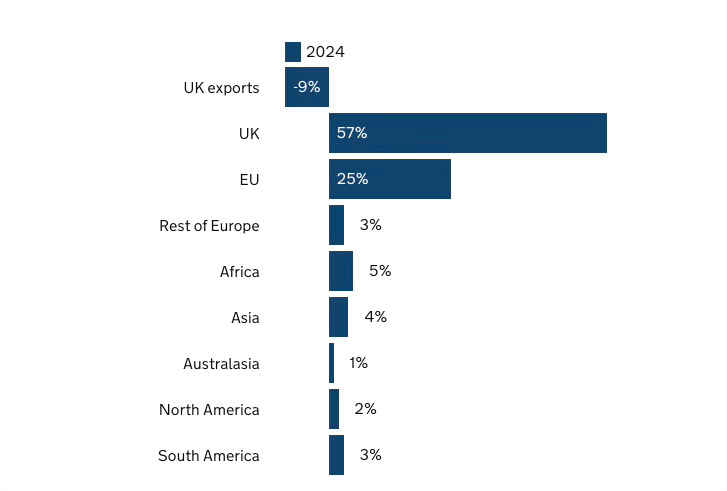
And finally, the numbers are what really make this non-issue the most stark. A full 69% of Britain’s land area is agricultural land, and as of December 2024, just 0.1% was solar farms. So what problem are we actually trying to solve here?11
Argument 4: Energy sovereignty is a good thing

This is the argument I find the funniest. One easy way to land in a bad place when arguing on the internet is to transpose an argument because it feels like it is the right shape, even though the context is completely different.
An obvious example of it now is how sometimes people try to argue that AI is not a major technological breakthrough, following the template set by cryptocurrencies and NFTs – even though AI is, obviously, a massive deal.
Anyway, I think something similar is happening here with the argument for ‘energy sovereignty’.
In principle, controlling our own energy system is hugely important. Recent years have taught us how precarious it is if oil and gas prices are set by Russia and events in the Middle East.
But this argument does not transpose well from fossil fuels to renewables.
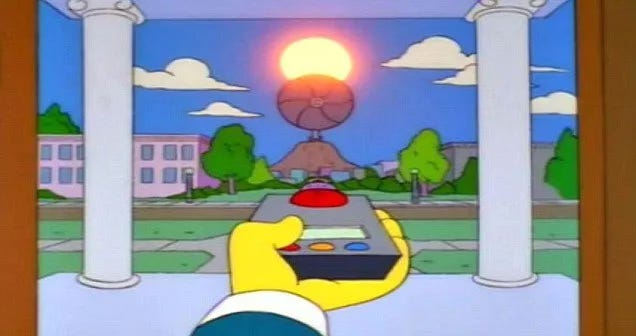
Why? Because unless Putin follows Mr Burns’ lead and attempts to block the sun, who owns the solar farm does not actually matter all that much as long as it is physically located in Britain.
This is for obvious reasons. Unlike our gas power plants, our solar farms do not rely on a steady stream of raw material getting shipped in from some of the world’s most volatile regions.
And even if we were to go to war with Australia for some reason, the physical energy generating infrastructure will remain intact and will continue to work as the sun will continue to shine. So the biggest problem in that scenario will be a severe lack of bar staff in London.
However, more seriously there is a real energy sovereignty argument – it’s just not the one being made above. But let’s quickly steelman it for good measure.
And that real argument is, of course, China.
If a Chinese company owned a solar farm in Britain, I would definitely be slightly more concerned. Let’s imagine if a Chinese firm bought East Pye from Macquarie. I don’t want a strategic adversary of Britain to potentially have an ‘off’ switch for thousands of homes.
But even if this were the case, in a crisis the infrastructure is still ultimately in Britain, so there would be little to stop the government taking control – as it did with the emergency nationalisation of British Steel last year.
But that is just operations. What about manufacturing? It’s not clear where East Pye will be sourcing its panels from, but given that 80% of global photovoltaic manufacturing is in China, Chinese panels are pretty much an inevitability.
So is this a case for caring more about energy sovereignty? Perhaps. But if it is, it’s also a case against building any solar at all.
Take climate change seriously
The reason I’ve spent upwards of 3,000 words getting mad about this is because unlike many Green activists and politicians, I take the energy transition seriously. If we want to mitigate the worst impacts of climate change, not to mention secure our energy supply against global instability, we need to move to renewable energy with a sense of urgency.
“Emissions must peak in 2020 and start stabilising, reaching net zero by 2030. The urgency of the situation should not be underestimated,” wrote the authors of Energising The East, a report on energy transformation in East Anglia, published in 2020.
It was commissioned by the aforementioned Catherine Rowett, back when she was an MEP, and I couldn’t agree more with the sentiment.12
However, it is now 2026. The 2030 deadline she endorses in the report, and the one set by Ed Miliband for decarbonising the grid, is now only four years away. So what are we going to do?
If we’re serious, we cannot let perfect be the enemy of the good. We don’t have the time to indulge unworkable fantasies about community ownership, or waste time pretending there are get-out-of-jail-free cards. We need to to build more renewable energy at an industrial scale.13
And if we want a grid in the future that isn’t just occasionally net zero, but is permanently net zero – then we need to start building now.
If you’re interested in politics, policy, and actually being sensible about things like energy and climate, then make sure you subscribe (for free!) to my newsletter to get more like this in your inbox.
The current government had a net zero grid by 2030 as one of its core missions (remember those?). But pretty much everyone who knows what they’re talking about seems to think this is, er, optimistic, even in the best case scenario.
If you’re not as compulsively online as I am, then the “checks notes” thing is a decade-old meme.
If you think putting solar panels in a field is controversial, just wait until you try to put solar panels in a historic conservation area.
It’s less clear how both East Pye and Amazon define a “home” here, so I’m using the MW figures for comparison.
Presumably you could also make an argument about expertise here too. Macquarie has another 21 sites across the UK, so can presumably deploy experienced people to manage construction and run the operations once it is complete.
Say, if energy prices were to dramatically fall, and the economics of solar were to dramatically change.
I think a less generous reading of the pushback I received seems to be people getting mad at basically the concept of a private company making any money at all. In which case I’m not sure how to argue.
I’m not going to claim this is generalisable, but these sheep seem pretty chill about having solar panels in their field.
Slightly worryingly, the BBC Bitesize website, which is aimed at kids, has a whole page perpetuating the food miles myth.
Or 77% in terms of “indigenous” food, if you want to live on a diet of turnips.
In fact, the numbers are so stark that it has made me think. Imagine if a full 5% of Britain’s land was used for solar farms – leaving 64% for farming. If they were built with the same generating density as East Pye, by my back-of-the-envelope calculation we’d have 472.1GW capacity. Multiply that by 365 and Britain’s median photovoltaic load capacity of 9.2%…. and admittedly, er, we’d need a few batteries, but that would easily cover all of Britain’s energy demand for the year.
On the actual substance of the report, I… disagree… with a lot of it.
It's a throwaway caption, but I think this is actually quite an important point:
"Though I guess it’s quite easy to picture some solar panels in a field"
I generally find people imagine enormous rows of bleak blackness. But having travelled through northern Germany last year, I was surprised at just how unobtrusive many are. They are slightly lifted off the ground, meaning lots of green and biodiversity underneath. But not high enough off the ground to be visible from outside the field.
Great article. Definitely worried about the First Australian War and the consequent London bar staff shortage now though.