



POD! On The Abundance Agenda this week, we talk about why the National Grid’s connection queue is broken – and screwing up Britain’s ability to build homes. Martin takes us back in time for a heartwarming Christmas tale about British infrastructure. And we speak to London Assembly Member James Small-Edwards, about his new report on how data-centres and homes are fighting for London’s scarce electricity supplies. Listen here, or wherever you get your podcasts!
Traditional politics has a problem with young men.
Sure, they don’t vote with the same enthusiasm as older generations, but with the rise of the manosphere, the re-election of Donald Trump, and the surprising social media success of Reform UK, it’s clear that something is going on. Today, Nigel Farage is the most followed MP on TikTok, with 1.4m followers.
We can also – possibly – see this in polling data too.
Though Reform only captured 12% of the 18-24-year-old male vote in last year’s General Election, there are signs that Farage’s party is gaining ground with Gen-Z men.
For example, according to JL Partners polling for the think-tank Onward, 31% of men aged 16-25 back Reform – compared to just 18% who support the Labour Party.
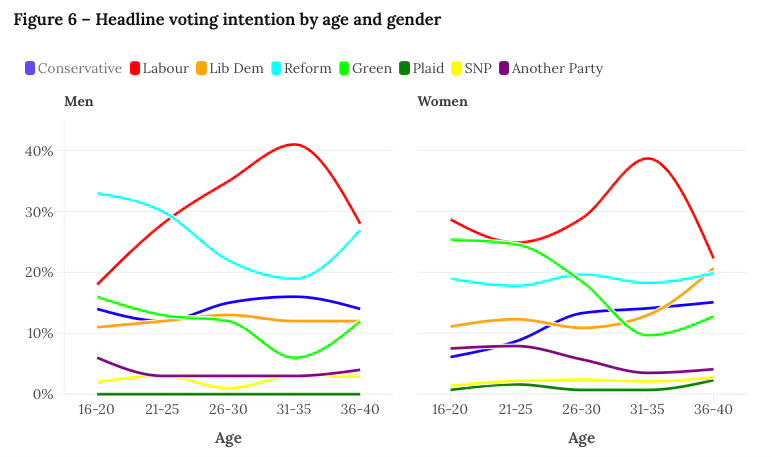
However, I’m not entirely convinced by this polling, as I can’t find similar data elsewhere, because annoyingly the major pollsters only seem to split out their tables by gender or age, not both at the same time.
The closest I’ve found is a reference to polling by More In Common by Laura Kuenssberg, where she suggests that in an average of four polls carried out this autumn, Reform was leading among young men who don’t have a degree.1
But in any case, whether or not the above polls are outliers doesn’t really matter. Because we all know that as things stand, at the next election Labour’s primary opponent will be Reform.
And even if Farage only captures a smaller proportion of young men than Labour, it could still be what makes the difference between a Labour majority, a progressive coalition – or Nigel Farage in Downing Street.
So this is all to say that aside from everything else, Labour will need something to offer this group, who are typically thought of as wildly disaffected, and as a cohort who spends more time on their Playstations and Discord servers than they do thinking about politics.
This means that even if Labour does come up with a serious policy offer on important young-people issues like housing, childcare2 and education, it will still struggle to get a hearing, as it will need a way to reach them too.
This is a hard problem, and no one has yet landed on a good solution, because traditional media is a dead-end, and social media – particularly the male-coded parts – are not exactly friendly territory for centre-left politicians. It’s hard to imagine Keir Starmer bantering with the Sidemen, or surviving an ordeal with Triggernometry.3
However, I think there could be a way to reach disaffected, Reform-curious young men and get their attention. And the secret is to serve the interests of a wildly underserved interest group, where a significant proportion of members are these hard-to-reach Gen-Zs.
That’s right. I’m actually serious. I think it’s time for Labour to become the party of… gamers.
And I think that Labour should fight the next election with a ‘Gamer’s Charter’.
So let’s dig into what it could include – and why I think it will work.