


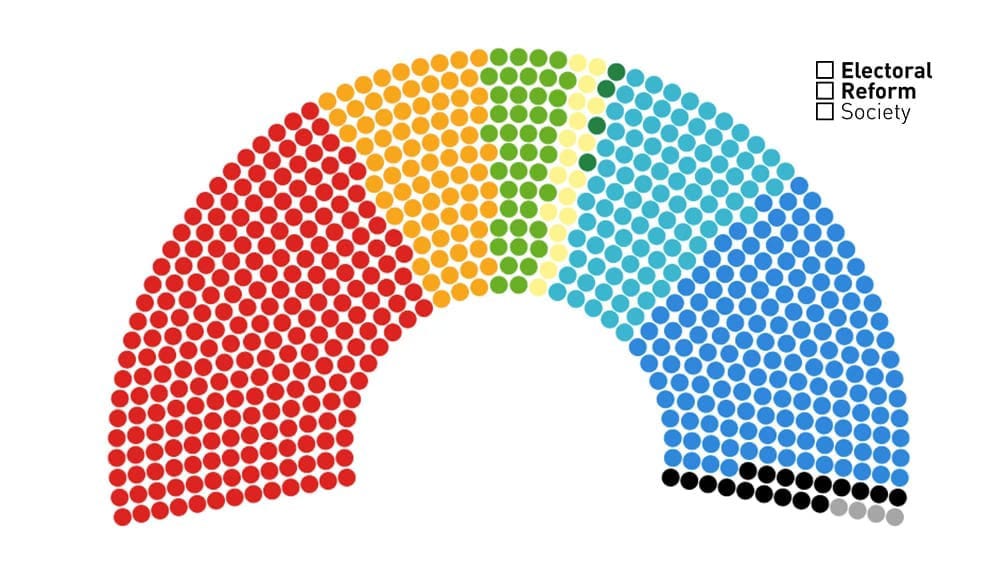
Hello! I’m on holiday for the next few weeks. I’ve got some cool guest posts coming up from some excellent people, and will still hopefully be publishing my ‘Odds and Ends’ links newsletter.
But I couldn’t let you go without a local elections take. It’s lucky, then, that… I’ve already written one. I first published this as a paid post back in March, and now it is more relevant than ever. So please enjoy my take on why now could, conceivably, be the moment for proportional representation.
(And if you value my work, please consider joining as a paid subscriber, as it is only with your support that I’m able to write every week (er, aside from the weeks I’m on holiday).
British politics is in flux.
Reform is slowly sapping support from the Tories on the right, and as the Gorton and Denton by-election evidenced, the Greens are now a serious force on the left, capable of stealing even the safest of seats from Labour.
Then there’s the LibDems, who are still there, occupying the lane of being a suitably inoffensive vessel for people who don’t mind immigrants and don’t like houses.
Together, this adds up to something unprecedented. For better or worse, we’re now living in an era of five-party politics – but this isn’t the interesting part.
What’s more notable is how these unusual circumstances have quietly aligned the incentives of all five major parties so that today, in theory at least, they would all stand to benefit from electoral reform, and a shift to proportional representation (PR).
So I know this sounds mad, but I can’t help but wonder if this means we’re at the closest point we’ve ever been to a change in the electoral system.
And now I’m going to explain why.
Five-party politics
The fragmentation of British politics isn’t a new trend. It’s arguably been happening for a generation – save for the weird blip of the 2019 election.1 Perhaps the starkest illustration of this recently is a YouGov poll that was published earlier this week. Shockingly, it shows the Greens overtaking Labour and leaping into second place – behind Reform, the other insurgent party.
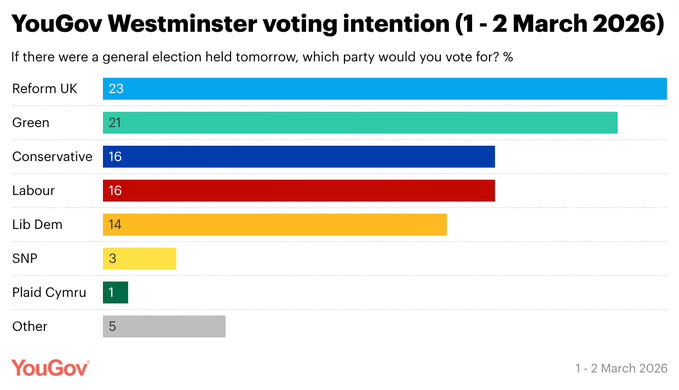
I’m guessing this poll will turn out to be an outlier2 – but it does illustrate the general trajectory we’re on. And the upshot of this is that now they all have credibly high polling numbers, the potential range of outcomes in a general election becomes absolutely chaotic.3
A good way to illustrate this is with Ben Ansell’s excellent seat calculator, which takes projected vote shares like you might find in a poll, and translates them to how many seats each party would expect to win.
So let’s imagine for a moment that the Tories are on 16.8%, Labour on 16.7%, LibDems on 15.8%, and the upstart Greens are on 21.5%, and Reform leads the pack with 23% – numbers that aren’t a million miles away from the YouGov poll above.
According to the calculator, those numbers would result in the right-wing bloc – Reform and the Tories – having a combined total of 273 seats, and the left-wing bloc – Labour, the LibDems, and Greens would have 279. Both are below the threshold for an outright majority, but it would give the left coalition first dibs on forming a government.
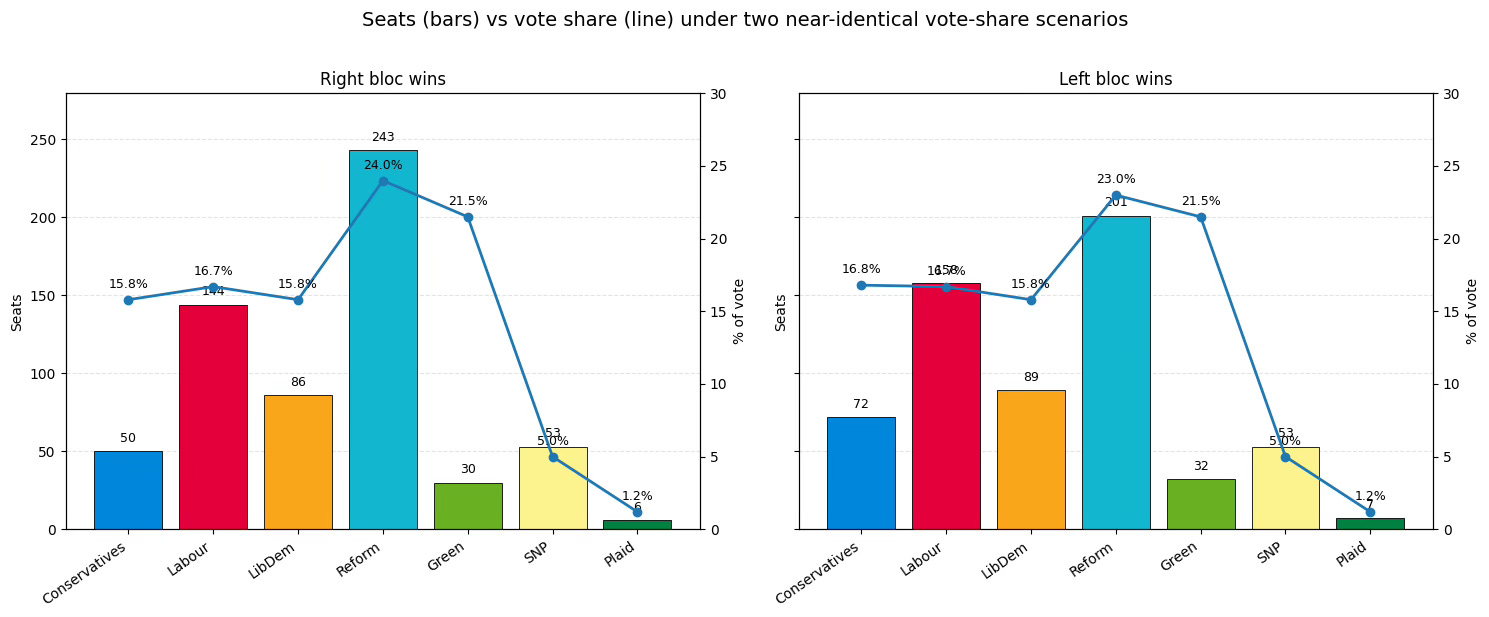
Now let’s take just one percentage point from the Tories and give it to Reform. A microscopic shift, yet suddenly the right bloc wins 293 seats to the left’s 260, and Nigel Farage is heading for Downing Street instead.4
In a nutshell, then, this highlights the problem with five-party politics under our First Past The Post (FPTP) system. Five parties in competition basically destroys any connection between vote share and the number of seats won.
As Rob Ford wrote, a few months after the last election:
“Aggregate poll numbers are all but useless as a guide when so much turns on geography and local variations in opponents’ strength. Labour, for example, could win another big majority with a lower overall vote share than now, or lose their majority altogether with a higher overall vote share - everything depends on where the gains and losses fall, and how local competitors fare.”
And this… seems like a bad situation to be in, as it works for basically nobody.
For voters, it turns politics into a meta-game of guessing how to vote tactically (as we saw in Gorton and Denton). For parties, it makes it difficult to campaign, as it isn’t clear who the enemy is, and how best to attack them.5
And for everyone else, it just creates a huge amount of uncertainty about the future. Which isn’t great whether you’re an election junkie reading a politics newsletter, or a business trying to make an investment decision.6
Why PR is more possible than ever now
This brings me back to proportional representation.
As you can probably sense, I’m broadly in favour of PR. I wouldn’t necessarily rank it on my list of the most important political issues, and a bit like the people who worry about the birth rate, I think if you make it your main thing it probably makes you a bit of an oddball.
But I’m not interested in making the case for or against PR in this piece – I know about 40 people (most of whom are LibDems) who could bore on at punishing length on the merits of different voting systems.7
The point I want to make here is like I say at the top – whether good or bad, I think the current circumstances are the best they have ever been, in terms of making the case for PR.
And I say this not because I’m looking at a poll going and thinking that it would be much simpler that way, but because if you look at the incentives and objectives of each of the five major parties, you can see the stars aligning in support of PR.
For the LibDems, Reform and Greens, the case for reform8 is obvious: It’s an opportunity to bag themselves more seats, and lock in a permanent place at the top table of British politics. If we switched to PR, every election would result in coalition negotiations, where the insurgent parties could score themselves cabinet seats and policy commitments.9
But what about Labour and the Tories? Unusually, both parties are bleeding support at the same time to insurgent parties on their flanks, and this flips their incentives.
For the Tories, Reform is at this point an existential threat. There’s a very real possibility that by 2029, Reform is the undisputed dominant party of the right.10 If that were to happen, there would be good reasons for the remaining Tories in Parliament to cast aside the party’s historic support for FPTP, and back PR as a survival strategy. This would be the best chance of avoiding total destruction, as it will be easier to scrape together a Parliamentary Party from the dregs of every seat, rather than hoping for wins in specific places.
Then this is more speculative, but for Labour, the situation could be similar. The Greens have not made quite the same inroads yet, and the structure and demographics of Green support could put a ceiling on just how many voters the party can conceivably steal. But if the Greens continue to poll strongly, it could scare the hell out of plenty of Labour MPs in urban centres, and push them to look for an emergency brake.
And this is not to mention that the party also faces significantly more internal pressure, as many Labour activists and MPs have long campaigned for PR as a point of principle. In fact, Labour MPs were raising the issue in Parliament just last week.
So this is all to say that taken together, we’re in the strange position where all five parties could conceivably align around changing the electoral system. Because of the unique circumstances they’ve all found themselves in, there could soon be an increasingly strong incentive to change. And given that the parties who stand to lose the most by not changing, are the ones who – until 2029 – hold most of the power then… I won’t be surprised if those parties start taking the PR option seriously.
It still won’t happen
So what I’m observing here is a historically unusual alignment of incentives, and this is notable because it is in situations like this when dramatic changes can happen.
In fact, this sort of alignment of interests is why we ended up as a Parliamentary Democracy in the first place.
As Francis Fukuyama argues in The Origins of Political Order, in 1688 as a result of the Glorious Revolution, constitutional government emerged almost accidentally, as it just so happened that the balance of power at the time did not advantage either the aristocracy or the emerging class of business elites and tradespeople. One side could not completely dismantle the other, so an early form of modern constitutional government arose as basically a compromise.
But this isn’t to say that I think a change to PR is likely.
The problem with electoral reform has always been the fundamental coordination problem – and that applies even when on paper, everyone should be aligned. For the party in power, even though it might make rational sense to change course, when looking at polling evidence, status quo bias is very powerful, and MPs may still be reluctant to roll the dice on change.
The same goes for individual politicians, as unless the expected outcome is total wipeout, there will still be MPs who resist because of either their own personal circumstances (ie, an enormous majority) and the irrational belief they have a special personal vote that is immune to political trends, or simply because of principle-driven support for First Past The Post.
Then there’s the fact this alignment I’ve identified is fragile, and the polls could still shift dramatically. Who knows what impact a new Labour or Conservative leader might have? What if Ed Davey is forced to retire after a waterskiing accident, and a chaotic LibDem conference anoints Lembit Opik as the new party leader?11 What if Reform receives some proper scrutiny from the press and everyone realises that an ideologically incoherent party of Putinists and weirdos isn’t as appealing as it once appeared?
And this isn’t even to say anything about the process by which the electoral system would change. Every spod in Westminster would be wading in on the merits of different proportioning systems, which would be unbearable. And then it might have to (God forbid) go to a referendum.
So to be clear, my argument here isn’t that it will happen. What I’m arguing is that the underlying circumstances of British politics are the best they have ever been for electoral reform.
It’s a bit like how if I were to lose half my body weight, I’d technically be in the best position I’ve ever been in to win an Olympic medal. But actually doing so would still be vanishingly unlikely.
So electoral reform might not happen. It probably won’t happen. But if it is ever going to happen – now might be the time.
What made the election weird was two things: It was the election that settled Brexit once and for all, coming off the back of endless Parliamentary shenanigans in a hung Parliament. And, of course, Labour was led into it by Jeremy Corbyn, who was successfully/accurately framed as a uniquely dangerous figure. Both factors are part of what led to Boris Johnson claiming such a commanding victory.
A friend who works in polling laughed when I mentioned the poll and told me that he thinks it is obviously wrong. But even if it is an outlier, good on YouGov for publishing.
At the time of writing the Prime Minister is still Keir Starmer, but who knows – perhaps by 2029 it really will be time for “Chaos with Ed Miliband”?
For the sake of ease, I haven’t factored in tactical voting here, which is something you can mess about with on Ben’s model. But suffice to say, that would add even more chaos into the mix.
We can see this in how Labour is deeply divided between whether to position itself for a fight with Reform or a fight with the Greens. And in how the Tories seem to be moving right in a suicide pact, instead of moving to occupy the wide open space on the Cameron-esque centre-right.
Oh, and it’s probably also bad for democratic legitimacy if the public can’t see a connection between who they vote for and who wins the election too.
I haven’t thought about this too deeply, but I quite like the German system where a perma-centrist coalition can lock out the crazies.
God it’s a nightmare having a political party named ‘Reform’ and wanting to use the word ‘reform’.
It would also satisfy their activists who have long called for it.
Arguably this has already happened given the relative attention paid to both parties. And I mean hell, when Mel Stride stood up to respond to the Spring Statement on Tuesday, my first thought was, “Oh, so that’s what he looks like”.
Whenever I try to read about internal LibDem party politics, I wonder if there’s such thing as too much democracy.
I think you’ve left out one key factor - Starmer is likely to be replaced before the next GE, and that new Labour PM is going to want some big policies to signal change and appease their base, and also not be the person who gives Farage a majority.
A switch to PR or a referendum on it is a way for them to win over party activists without having to spend billions.
I’m firmly in the camp of electoral reform as soon as humanly possible. But I don’t think this is something a government should simply do by using its majority to push it through.
Given how badly we have been engaging with one another since at least the Brexit campaign, and given how toxic almost every discussion about almost every positive proposal seems to become, this has to be a shared endeavour. There are also many possible forms of PR or electoral reform each with their pros and cons (the version we had on offer in 2011 would have been an improvement on the status quo but for me its flaws meant I didn't vote in support).
So something of this magnitude, in this climate, with consequences that would last well beyond one parliament, needs a different approach. A national conversation that is absolutely rooted at the local level. So imo we need to do something genuinely radical: use a citizens assembly methodology. Not one national assembly, but several regional ones, rooted in different places and political cultures. It's being tried for digital identity so at least it wouldn't be completely unprecedented (though we're yet to see how that goes).
Labour can't begin this process on its own because that's the quickest route to it being dismissed as a stitch-up, it has to be an invitation to other parties, to citizens, and to the country as a whole. The assemblies need to have teeth, including the freedom to explore all serious options for electoral reform and to make binding recommendations about how the country proceeds.
We have become ever more fragmented, and it feels like so many of the elections in my lifetime have become exercises in protest, disappointment and point-scoring rather than a genuine expression of every person and every vote. We have to take the chasm of public trust seriously and so acknowledge we're starting from such a low base that any change has to work out from that deficit (UK trust in national government is amongst the lowest recorded anywhere in the world), then the way we approach reforming our democracy has to model the future vision of the democracy we are trying to renew.