


POD! On YIMBY Pod this week, we speak to former TfL head of innovation Thomas Ableman about why Swiss buses and trains work in perfect harmony – and why we need to build our own ‘mini-Switzerland’ in Britain. Plus Martin digs into the wild success of the British wine industry, and how it’s all thanks to robots. Listen/subscribe here.
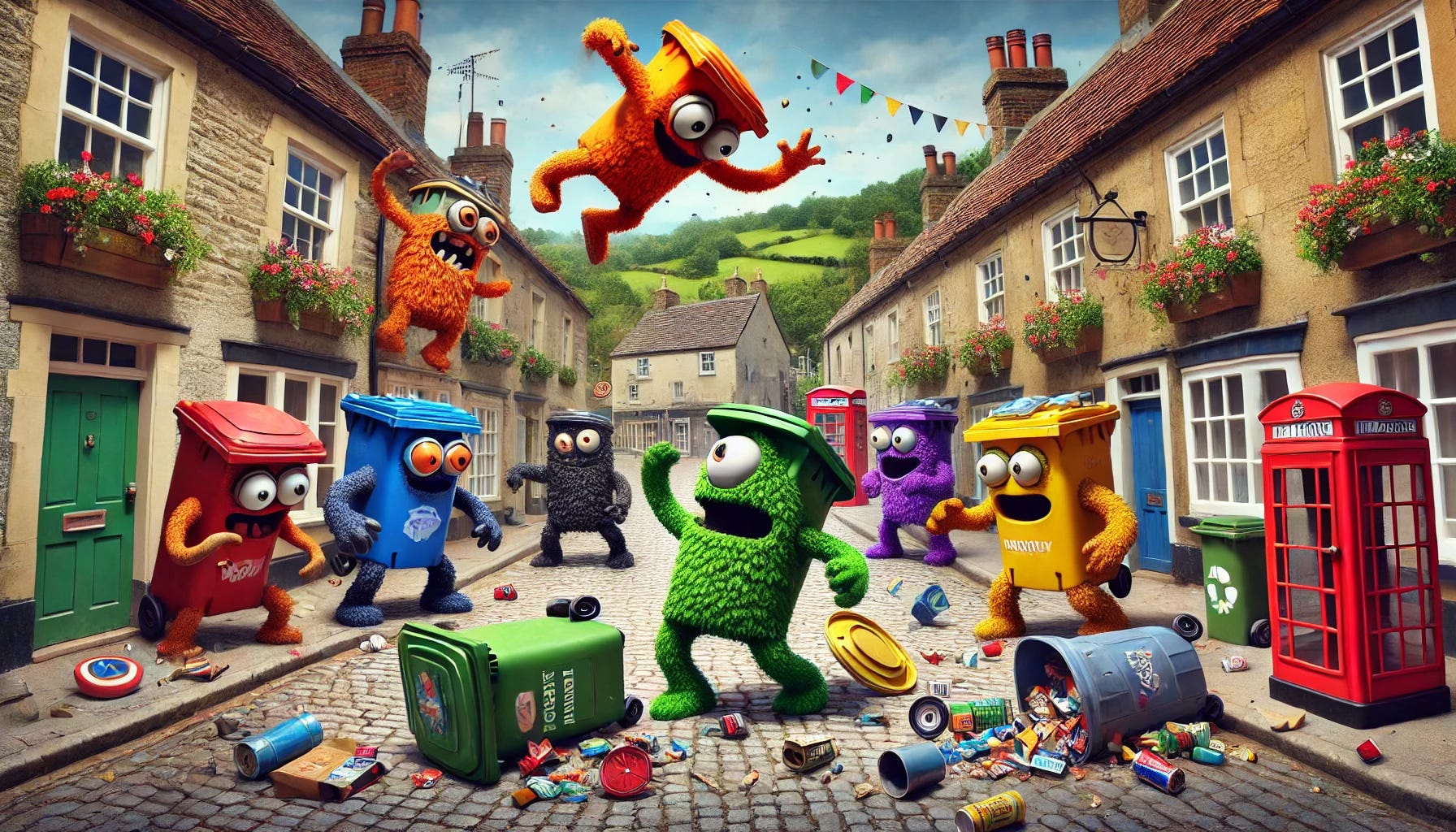
Today there is very big bin news! In England, new rules are now in force requiring councils to provide weekly food waste collections, which in practice means that you now need to have a fourth bin outside your house.
So to, er, celebrate, I thought I’d send out again this fantastic guest post that my partner, Dr Liz Lutgendorff, wrote for me just over a year ago. (Don’t worry, a brand new essay on an extremely controversial topic and your regular Odds and Ends links newsletter will be landing later this week. So stay tuned!)
Anyway, back when Liz wrote this, she was working in local government, attempting to digitise London’s waste management, so I had to ask her… How many bins do we actually need? Why do some people think we need seven?! And how many bins is too many?
So here she is with… the seven things you need to know about seven bins.
1. It’s easier if you separate at source
How many bins do we need? The answer… is complicated.
Generally, from the perspective of the waste management industry, the more bins we have the better. The best way to increase recycling is to separate waste at source, because it means that you do the hard work.
This is because it’s very difficult to separate different types of waste when they are all mixed together, and the more work the local authority has to do when it receives your waste, the more expensive it gets.
And it is especially the case when there's ‘residual’ waste – basically everything that doesn’t go into your recycling bin. It just isn’t economical, safe or sanitary to separate out food waste from random plastic wrappers, nappies, cat litter, or ‘Free the PAF’ badges.
This is why I think new rules that mandate separate food waste collections from next year are a good thing, because if food is properly separated, it can be composted and therefore turned into something that can be reused.
2. It’s all about money
Legislation prescribes the types of collections that can be made available in your local authority, but what happens to waste in your area is mostly up to your council. And that can be dictated by a number of things, but one of them is the cost of disposal.
Recycling is better to dispose of because there’s often a commodity at the end that can be sold on, so the overall cost of the disposal of your grass clippings or baked bean tins is lower than the disposal of your kitchen black bag waste. 1
But not everything is as saleable or easy to dispose of.
For example. extracting metals from waste electronics is, in theory, valuable. There are people willing to pay for copper, aluminium, and so on. But the problem is that the disposal cost might still be relatively high if the device requires multiple different recovery processes to be run.
So if you want to recycle something that is hard to recycle, the cost of this disposal is also higher.
3. Dirty power is better than the alternatives
When your bins are collected, the trash is taken either to a Materials Recovery Facility for recycling – or sent on for either landfill or incineration. Crucially though, the latter is now the cheapest way to dispose of waste.
Big items, like a knackered old sofa, can be shredded first, but ultimately everything sent to the incinerator is going up in smoke.2
And this can be controversial.
There was an article on the BBC in 2024 on how incinerators are now the UK’s dirtiest form of power.3
That might sound bad, but it’s important to remember that an incinerator is not an intentional energy source. Energy is just a byproduct of the most environmentally friendly and lowest cost method of disposing waste that doesn’t have any saleable value after processing or recycling.4
And there are safeguards on this. All incinerators have permitted levels of what pollutants they can release, it’s heavily monitored, and anytime there’s a breach of those levels, the Environment Agency needs to be notified.5
That’s why nitrous oxide – laughing gas – is so annoying. Lately there’s been an epidemic across the country of nitrous oxide bottles ending up in incinerators, exploding during incineration, and instantly breaching the emissions allowed for the day.6
Incineration then is not perfect, but landfill is worse,7 and it’s what we’ve got to work with right now if we don’t want rubbish piling up in the streets.
4. Capitalism is garbage
If you want to get philosophical about things, you might wonder why we have to pay for so much waste disposal?
The answer is because of the way that products are manufactured and sold to us.
Most things (or the packaging they come in) aren’t recyclable8 and the companies that produce them generally don’t have to care about that. The end result is that the cost of disposal is passed on to us, through councils, who have statutory obligations to reduce waste and to ensure it’s properly disposed of. So pound shop tat, fast fashion and Temu purchases aren’t the deals they appear to be, at least when looked at from a whole-systems point of view.
One small step that the UK is taking however,9 is the introduction of Extended Producer Responsibilities for those companies that have plastic packaging. Essentially, companies will have to pay the government when they use certain types of plastic, and the government will give councils a proportion of that cash, as they will have to pay for its disposal.
But the problem is not just plastic packaging, it’s the entire ecosystem that encourages excessive consumption. And working out what is the least wasteful way of doing things is often tricky.
For example, there’s a popular idea now about ‘cost per use’ - not just from a monetary point of view but from the environmental cost associated with production. If you buy a canvas bag, the materials and production costs mean that you probably have to use that bag about 1,400 times for it to have a net environmental benefit.
Similarly, buying glass or (even worse) metal containers is not necessarily more environmentally friendly than plastic because of the greater effort / processing involved in its creation.10 Driving across a city to go to that one store that allows you to fill your own containers may not be worth it for the petrol you are using to get there.
And if you want some tragic news about your compostable cutlery, it’s often not actually compostable. Common recycling processes like anaerobic digestion or open row composting don’t break down the materials in the same way as organic matter. In fact, most ‘compostable’ packaging needs a specialist recycling facility, so your ‘biodegradable’ spork will probably be treated as a contaminant and will be incinerated.
So there’s mismatches between what is perceived to be environmentally friendly and what is perceived as the least friendly.
However, this doesn’t meant that trying to be sustainable is impossible. The best way to deal with your trash is not to ‘wishcycle’11 by throwing stuff in the recycling, and hoping that the material processing facility will be able to deal with it. Just throw the spork in the bin, as at least it’ll be turned into energy.12
5. It’s commodities trading all the way down
The best way to think about waste is as an industry. Everything around the disposal of your household waste is big business.
Firstly, your council will have one or multiple contracts for the disposal of what is picked up from your kerbside. Then there are more specialised recycling organisations for more niche recycling products, like paint, ink cartridges, car batteries or even used oil.
These organisations will either be the place where these commodities get recycled, or they will be a middleman, selling it onto another company, who can turn it into another product.13
There has been a lot of consolidation in this space, and today many waste organisations are huge multinational conglomerates. And this means that there is a trade-off.
On the downside, this consolidation could mean that waste will travel further to be processed, as we’ve seen with waste being shipped abroad just to be incinerated. And it could conceivably be bad news for local democracy, as it means there is less choice and competition for your council to get the best deal for their residents.
But there is a potential upside too, as having a larger company involved makes it easier to aggregate difficult materials, thus making recycling more profitable – meaning that in theory, more stuff will get recycled.
And of course, there are also a lot of community led organisations that will recycle niche products that are hard to deal with too.14 But these tend to rely on the good will of individuals, councils or grants to continue operations (not to mention space to store stock).
6. Recycling rates are class war
To bring it all back to bins, recycling is arguably the pastime of relatively affluent, sometimes rural, middle-class people.
The way local authorities are measured on recycling is with a ‘waste data flow’ return.15 This is a statutory obligation to report the final disposal destination of every type of waste that is collected.
So it might record, for example, that your residual waste ends up as ash and gets turned into some aggregates, or that your paper gets shredded and ends up in Indonesia.16
But one other thing that gets included in a local authority’s recycling rate calculation is ‘green’ waste: Your lawn mowing clippings or garden pruning. And this can hugely impact top-line recycling figures.
For example, rural areas with large gardens and fields have a much higher recycling rate. But inner city boroughs generally don’t have sizeable gardens or lawns to mow, so their recycling rates are usually lower.
However, this isn’t the only coefficient on the figures. Something else that affects whether your local authority has a higher recycling rate is how many people ‘participate’ in recycling programmes, and follow the rules instead of just dumping everything arbitrarily into their bins.
Some of what drives participation is socio-economic - some people don’t have space or time to bother. And some of it is also cultural - where handling waste is not culturally acceptable. So those communities will have higher recycling ‘contamination’ rates.
And this means that even if we have more bins, it wouldn’t necessarily lead to more recycling, in every case.
7. We need to build better to recycle more
If you want to help your council and feel virtuous about your impact on the environment, then you have to learn to love your bins, and also your local recycling centre. You should want more bins, as it will mean more things will get diverted from incineration.17
However, more bins is not practical for so many people - namely because they have no space, live above shops or just have really poor collection cycles.18
So if as a society we really want to minimise waste to the irreducible core, we’re going to have to think about the practical everyday lives of people and the built environment. The UK’s housing stock wasn’t built for multiple bins, and even today new builds aren’t prepared in many cases.
This means we’ve got to live with the trade offs of waste incineration if we don’t engineer our built environment to store multiple types of recycling in a straightforward way. That needs to be balanced against the cost of collection for local authorities and whether that can be reasonably collected in a time that people would find acceptable.
So in the end then, the number of bins isn’t the point. The real takeaway is that we all need to separate better—and that includes food waste, plastics, and our unrealistic expectations about compostable sporks.
Liz Lutgendorff is a digital transformation leader. Follow her on LinkedIn, Bluesky – and make sure to subscribe to her Substack, where she’ll be writing irregularly about how technology can drag institutions into the twenty-first century. You might also like this other one she wrote for me on why fixing the government can be a tech nightmare.

At least if your local authority negotiates a good contract.
There isn’t actually any smoke in modern facilities. Often what you see is actually steam from the energy being generated.
Because we’ve got rid of all the coal.
Or where incineration is one of the allowed methods of disposal, like waste that contains persistent organic pollutants (or POPs).
Just to emphasise that anything valuable will be recycled, the ash or metal recovered from the incinerator process is also a commodity which is collected after incineration and recycled. Aggregates baby! Also incinerators use enormous electromagnets to pick out the metal! You can’t go near it with a pacemaker, it’s that big.
There are also lots of fires caused by batteries. DON’T PUT BATTERIES IN THE BIN PEOPLE!
It’s also really expensive to use landfills. This was basically the result of the introduction of the landfill tax in the 1990s, which I read about in a dense, academic book about waste management that James gave me when I started my job. If you ever wonder how someone puts up with James and his nonsense, it’s because I consider this a very thoughtful gesture. [Not ‘romantic’? - Ed]
Again, individual parts may be, but to break down a plastic toy with multiple types of plastic, maybe some waste electronics, maybe some polystyrene makes it expensive and therefore impractical.
Plastics are also heavily recycled, so it’s likely that the plastic containers are fine if they are for multiple use.
I’ve written this entire pieces to shame James into not wishcycling. NOT ALL PLASTIC PACKAGING CAN BE RECYCLED JAMES. PUT IT IN THE BIN.
Just to make you feel worse, depending on the contract your borough has with its recycling facility, they’ll pay more for ‘contaminated’ loads, so don't guess!
One of the fun facts that I was told at a material recovery facility was that it takes about 20-30 days for a plastic milk bottle to go from entering the facility, to being back on a shelf with milk in it.
I recently got some solid walnut countertop to build a monitor riser from Solo Wood Recycling in Croydon, who were lovely. There was an ancient hunk of mahogany that I should have bought but I imagine none of my power tools would have been capable of cutting it.
I thought I escaped horrible orange government websites when we replaced DirectGov, but apparently not.
Fun fact. Waste disposal is global, so things like Chinese New Year will drive up the price of cardboard and paper. During the pandemic, because of logistics issues, the prices of a lot of commodities in the UK skyrocketed.
Another fun fact, because a lot of dry commodities like paper and cardboard don’t get incinerated, what’s left is a lot of wet food waste, which is harder to incinerate. So removing your left over dinner will probably make incineration a bit more efficient.
Our recycling collection is every fortnight but refuse is every week. We have way more recycling than refuse, but luckily we also now live in a house outside London and not in a split level house or behind a shop, like where we used to live.
True story and random claim to fame: way back in 2002, I was tasked with introducing recycling bins into Rushcliffe. We weren’t the first to do this but I came up with the ‘alternate week collection’ tag to get us past the flak we took for ‘halving collections’…. Anyway - the plan was for three bins: garden stuff, food stuff and everything else - with a sack for paper, plastic.
Right at the death, the government intervened over the food bin. This wasn’t long after BSE - and they stopped us on the basis that there was a risk that they would result in a higher risk of BSE. So I asked for a breakdown of their logic. It went something like this: food waste gets dumped, a bird flies over and picks some up, bird drops it in field, cow eats it and YIKES! Everyone dies.
So I asked for their calculation of the risk: 14 million to 1 came back the actual, no I’m not making this up answer.
So we were stopped on a risk factor greater than winning the Lottery jackpot.
So I consoled myself by rigging the public consultation exercise about whether we should replace the dry recyclables sack with a proper bin. Apparently everyone wanted one, hurrah!
Fast forward 24 years, and that’s a lot of food waste, wasted. I still haven’t won the lottery.
It'll depend on the contract how it's managed. Generally, there is always a low-level of non-recyclable material in any load, so it's pulled out as part of the materials recovery facility processes.
If there's a particularly bad load, it could be downgraded (so it costs more to process) or might be unsalvageable and treated as waste.
The behaviours around recycling are fascinating. Some are cultural (so people just treat a recycling bin as another bin), some are behavioural (football fans using them as bins on the way out of a game) etc.